Goal
Develop high-performance supercapacitor electrodes using siloxene nanosheets
Problem
Need for energy-storage electrodes with higher capacitance, energy density, rate capability and long-term cycling stability
Concept Summary
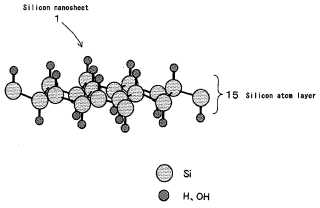
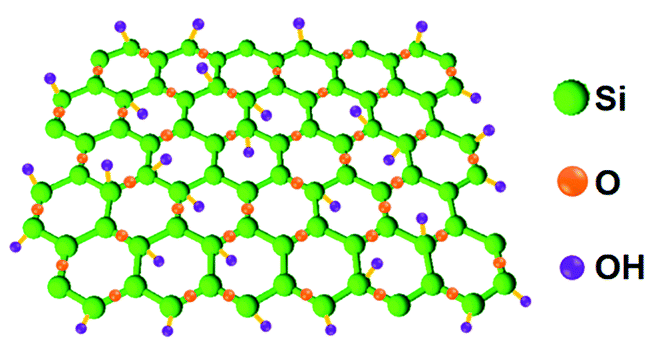
Siloxene, a two-dimensional silicon-based nanosheet functionalized with O, H and OH groups, is fabricated and used as the electrode material in a symmetric supercapacitor employing 0.5 M tetraethylammonium tetrafluoroborate electrolyte. The material exhibits pseudocapacitive behavior arising from ion intercalation/deintercalation, delivering high specific capacitance, energy and power density, and excellent cycling stability.
Principles
- Pseudocapacitance
- Ion intercalation/deintercalation
- Surface redox reactions
Scientific Domains
Materials
- Siloxene (Si6H3(OH)3)n
- Tetraethylammonium tetrafluoroborate electrolyte
Mechanisms of Action
- Charge storage via surface redox (pseudocapacitance)
- Ion intercalation into siloxene layers
Energy Sources
Applications
- Electrochemical energy storage
- Portable and grid-scale supercapacitors
Claimed Performance
Maximum specific capacitance 2.18 mF cm^-^2, energy density 9.82 mJ cm^-^2, power density 272.5 mW cm^-^2, and 98 % capacitance retention after 10 000 charge-discharge cycles.
Experimental Evidence
Cyclic voltammetry showed pseudocapacitive behavior; galvanostatic charge-discharge profiles displayed symmetric triangular curves; cycling test demonstrated 98 % retention after 10 000 cycles.
Replication Status
Results reported in a peer-reviewed journal; no explicit independent replication mentioned.
Limitations
- Specific capacitance lower than some high-surface-area carbon materials
- Requires careful handling of liquid electrolyte