Goal
Increase thermal efficiency and torque of internal-combustion engines while reducing fuel consumption and emissions.
Problem
High fuel consumption, pollutant emissions, and limited efficiency of conventional internal-combustion engines.
Concept Summary
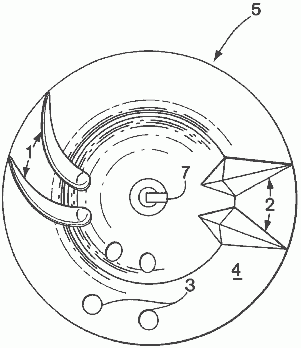
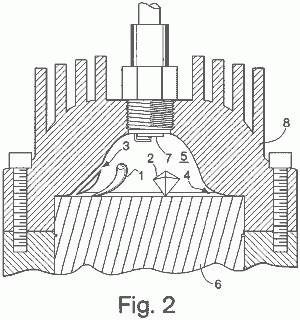
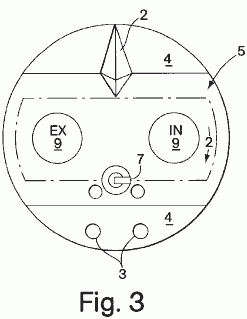
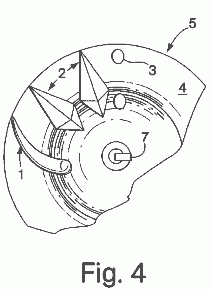
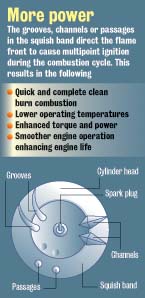
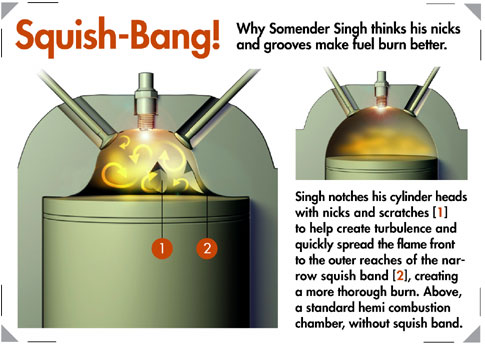
A concave steel insert with intersecting grooves is mounted in the cylinder head (the "squish-zone") to create intense turbulence during the compression stroke, improving air-fuel mixing and combustion speed, resulting in lower fuel use, cooler exhaust and higher power output.
Detailed Description
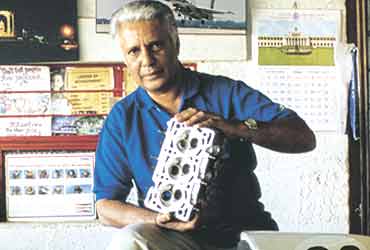
Singh's design modifies the combustion chamber geometry by adding a steel plate with four intersecting grooves (like compass points) that are scored into the cylinder head. The grooves create a "squish" effect that forces the air-fuel mixture into a thin layer, generating high-velocity turbulence at the moment of ignition. Laboratory tests on a test engine showed a reduction of fuel consumption between 10 % and 42 % and exhaust temperatures about 16 deg C lower than the unmodified engine. The same modification was later installed in a production car, where the driver reported smoother acceleration, ability to stay in fourth gear at 500 rpm, and a noticeable reduction in engine knock. The invention is covered by US Patent 6,237,579 (May 2001).
Principles
- Turbulence generation
- Enhanced mixing of air-fuel charge
- Improved flame propagation
- Heat transfer reduction
Scientific Domains
Materials
- Steel (concave insert with grooves)
Mechanisms of Action
- Squish-zone induced turbulence
- Increased swirl and tumble
- Higher combustion temperature and pressure
- Reduced heat loss to cylinder walls
Applications
- Passenger cars
- Motorcycles
- Light-weight aircraft engines
Claimed Performance
10-42 % reduction in fuel consumption, up to 20 % overall efficiency gain, exhaust temperature ~16 deg C lower, noticeable increase in torque and power.
Experimental Evidence
Test at Automotive Research Association of India (ARAI) reported 10-42 % lower fuel use and 16 deg C cooler exhaust on a modified engine.
Limitations
- No independent, peer-reviewed validation
- Limited data on long-term durability
- Scalability to high-performance or large-displacement engines not demonstrated
Red Flags
- Reliance on anecdotal driver reports
- Absence of published, controlled dyno testing with gas-analyzer data
- Potential for patent-driven marketing without rigorous verification