Goal
Generate lift and potentially harvest power using the Magnus effect in low-wind conditions.
Problem
Limited lift and power generation capability of conventional kites, especially in light winds.
Concept Summary
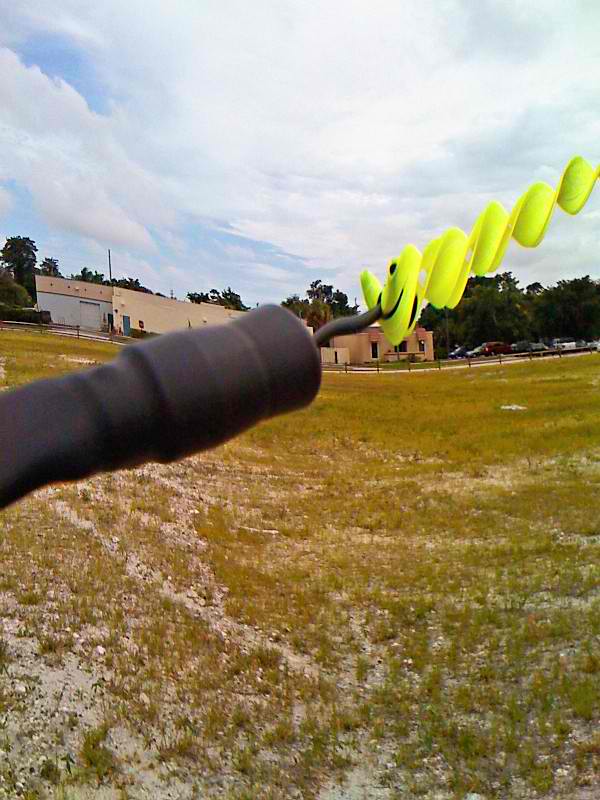
The Skybow is a long, flexible ribbon that spins rapidly about low-friction swivels. The spinning creates a pressure differential via the Magnus-Robins effect, producing lift that raises the arch into the sky. Center-weighting and tension distribution stabilize the ribbon, while multiple independently rotating sections accommodate wind-speed variations along its length.
Detailed Description
A Skybow consists of a ribbon made from a sandwich of high-strength tapes (e.g., 3M #863 monofilament-reinforced polypropylene tape, polyethylene adhesive tape, colored polyethylene bag plastic). A stretchy center-weighting layer adds mass without increasing stiffness. The ribbon is mounted on low-friction ball-bearing swivels at its ends (and optionally mid-span) that allow it to spin at several thousand RPM. In winds of 8-12 mph the ribbon can spin at 3-4 k RPM; in 16-22 mph winds speeds of 7-10 k RPM have been recorded. The lift generated can pull 17 lb on a 200 ft section and up to 33 lb on a 1000 ft section, raising the arch to 350-400 ft. The device is marketed for sport, education, and as a demonstrator of angular momentum, angular velocity, and the Magnus effect.
Principles
- Magnus effect
- Aerodynamic lift
- Angular momentum
- Rotational dynamics
Scientific Domains
Materials
- 3M #3750 premium box sealing tape
- Surveyors flagging tape
- Polypropylene gift-wrapping ribbon
- 3M #863 monofilament-reinforced polypropylene strapping tape
- Polyethylene adhesive tape (e.g., Frost King Weatherseal Tape)
- Colored polyethylene bag plastic (50 um)
- Ball-bearing fishing swivels (e.g., SAMPO)
- MR115-2RS stainless steel bearings
Mechanisms of Action
- Spinning ribbon creates low pressure on one side via Magnus effect
- Center-weighting slows transverse wave propagation, stabilizing torsional motion
- Low-friction swivels transmit torque while allowing free rotation
Energy Sources
Applications
- Extreme-sport kite
- Educational demonstration of physics concepts
- Experimental low-wind power generation
Claimed Performance
Pull up to 33 lb on each end of a 1000 ft skybow; spin speeds up to 10 625 rpm; arch height 350-400 ft; 17.68 lb pull recorded on a 200 ft section in 10-12 mph wind.
Experimental Evidence
Digital scale test showed 17.68 lb pull on a 200 ft skybow in 10-12 mph wind; video recordings of 5000-rpm spin; 33 lb pull recorded on a 1000 ft skybow; highest recorded spin 10 625 rpm (July 2009).
Replication Status
Various kite enthusiasts worldwide have built and tested skybows, reproducing the described performance.
Limitations
- Requires sufficient wind speed to achieve lift
- Material strength limits maximum length and load
- Complex swivel maintenance for long-duration operation