Goal
Provide a highly efficient transmission that automatically adjusts its gear ratio to supply the perfect amount of power for any load condition, improving fuel economy and reducing energy waste.
Problem
Conventional gear systems rely on fixed ratios or hydraulic mechanisms, leading to inefficiency, gear shifting, and poor torque-speed matching under varying load conditions.
Concept Summary
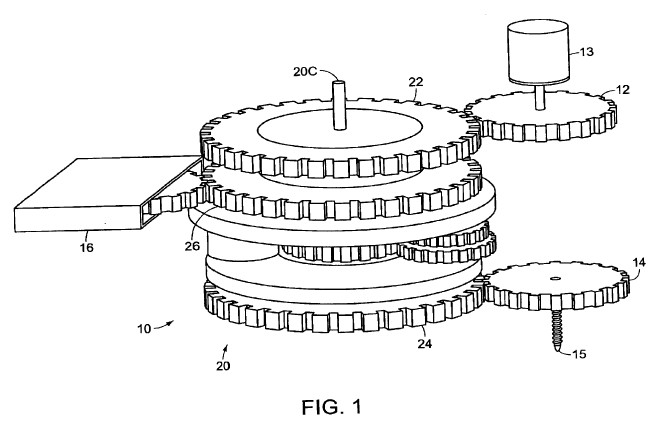
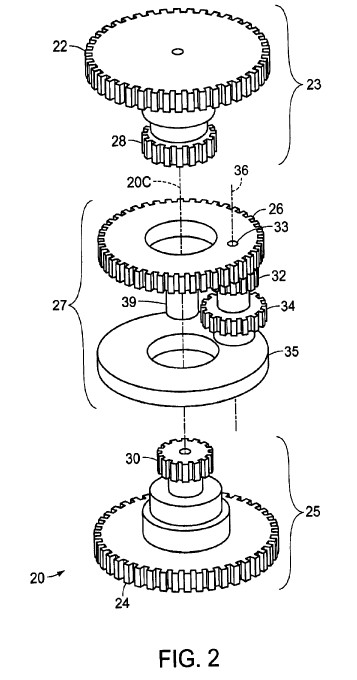
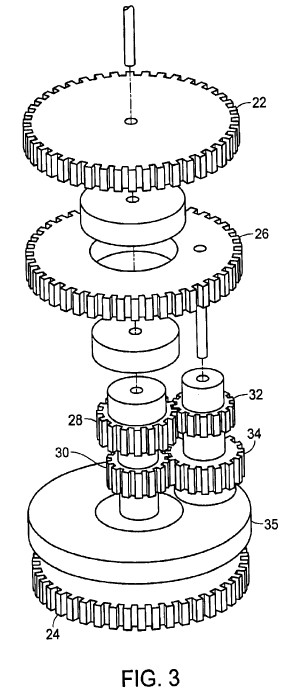
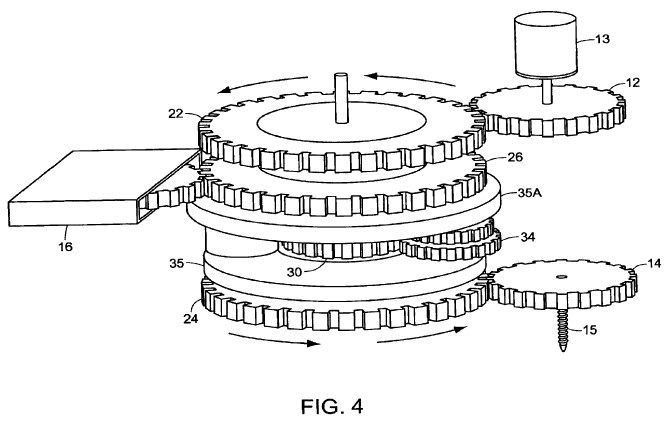
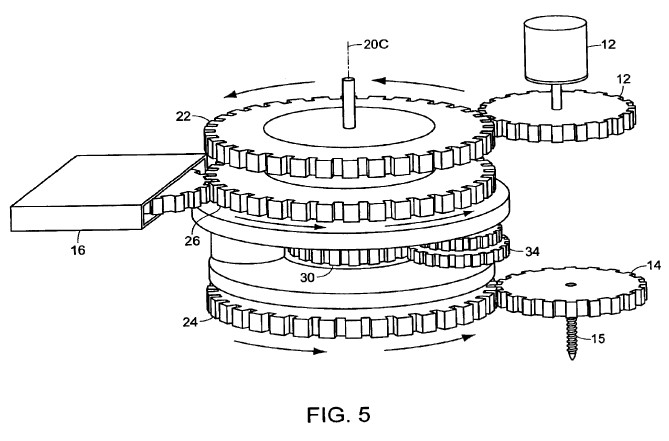
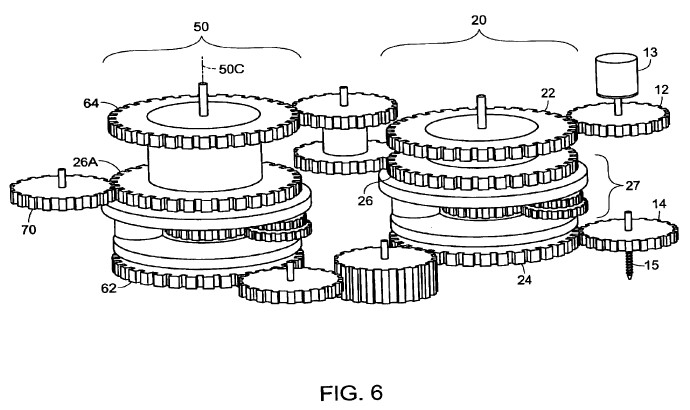
The invention uses a coaxial set of input, output, and variance gears. When the output gear encounters increased resistance, the variance gear initiates planetary motion around a motion-transfer gear, automatically lowering the effective gear ratio and increasing torque without stopping motion. A feedback control gear set can adjust sensitivity, allowing continuous ratio variation.
Detailed Description
The system consists of an input gear driven by a rotary power source (e.g., an electric motor), an output gear that drives the load, and a variance gear positioned coaxially between them. Under normal conditions the input drives the output through upper and lower motion-transfer gears. When load resistance rises, the variance gear begins to orbit the lower motion-transfer gear, causing the lower motion-transfer gear and output gear to rotate more slowly, thereby lowering the gear ratio and increasing torque. A secondary variance control gear set mirrors the input/output set and provides a feedback loop to modify the activation point of planetary motion. The design eliminates the need for hydraulic actuation or manual gear shifting, aiming for continuous, automatic ratio adjustment with all gears remaining in mesh.
Principles
- Gear mesh transmission
- Planetary (orbiting) gear motion
- Automatic ratio adjustment based on load resistance
- Feedback control via duplicate gear set
Scientific Domains
Materials
- Steel gears
- Aluminum or steel shafts
- Ball bearings
- Housing (metal or composite)
Mechanisms of Action
- Coaxial gear arrangement
- Planetary motion of variance gear
- Torque increase via effective gear ratio reduction
- Feedback loop using control gear set
Energy Sources
Applications
- Automotive transmissions
- Lawn tractors
- Mowers
- Industrial power tools
Claimed Performance
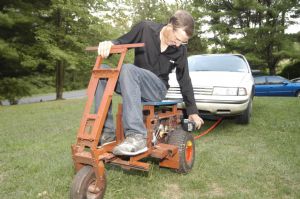
The prototype could pull the weight of a car using only a cordless drill as the power source, and the system is described as "highly efficient" and capable of improving vehicle fuel economy.
Experimental Evidence
A single demonstration model was built; it was shown pulling a car weight with a cordless drill and was photographed towing a car chassis.
Replication Status
Only one demonstration model reported; no independent replication or commercial scaling mentioned.
Limitations
- Only a single prototype built
- No long-term durability data
- Manufacturing tolerances for planetary motion not quantified
- Efficiency metrics not provided
Red Flags
- Reliance on a single demonstration without peer-reviewed testing