Goal
Create a carbon-negative, high-strength building material that can replace Portland cement.
Problem
High CO_2 emissions from cement production and the need for stronger, more durable construction materials.
Concept Summary
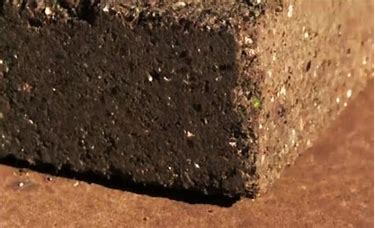
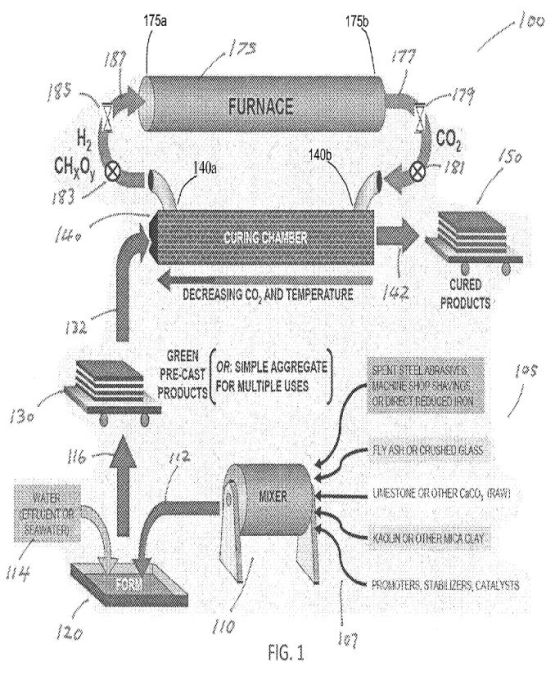
Ferrock is a cementitious binder made primarily from waste steel dust (iron powder) and recycled glass silica, combined with calcium carbonate, clay, and various fibers. When mixed with water and exposed to CO_2, the iron reacts to form iron carbonate, which hardens into a rock-like matrix that is up to five times stronger than conventional concrete while sequestering CO_2.
Detailed Description
The core of Ferrock consists of powdered iron or steel dust (~=60 % by weight) mixed with a silica source (recycled glass), calcium carbonate (~=8 %), a clay component (kaolinite or metakaolin, ~=10 %), and optional additives such as alumina, organic reducing agents (e.g., oxalic acid), and fibrous reinforcements (carbon, glass, or polymer fibers). The mixture is combined with water, poured into forms, and allowed to cure at ambient temperature and pressure. During curing, the iron dust undergoes carbonation with atmospheric CO_2, producing iron carbonate that bonds the particles together, creating a dense, rock-like composite. Laboratory tests reported flexural strengths and fracture toughness values several times higher than those of ordinary Portland cement after 6 days of carbonation. The material also exhibits resistance to saltwater environments, making it suitable for underwater applications. While the hardening process absorbs CO_2, the production of the binder itself releases some CO_2, resulting in a net carbon-negative balance when the material is used at scale.
Principles
- Carbonation of metallic iron
- Composite material reinforcement
- Sustainable waste-material utilization
Scientific Domains
Materials
- Steel dust (iron powder)
- Recycled glass (silica)
- Calcium carbonate
- Kaolinite clay
- Metakaolin clay
- Alumina additive
- Oxalic acid (organic reducing agent)
- Carbon fiber
- Glass fiber
- Polypropylene fiber
- Polyamide fiber
- Polycarbonate fiber
- Polyvinyl alcohol fiber
- Nylon fiber
- Fly ash
- Limestone
Mechanisms of Action
- Iron dust reacts with CO_2 to form iron carbonate
- Iron carbonate acts as a binding matrix
- Fibrous additives improve toughness and crack resistance
Applications
- Building foundations
- Precast wall panels
- Underwater structures
- Infrastructure components
- Architectural cladding
Claimed Performance
Up to five times stronger than conventional concrete; carbon-negative (absorbs CO_2 during curing); high durability and resistance to saltwater; can be used as a structural binder in precast and architectural applications.
Experimental Evidence
University of Arizona experiments produced a material five times stronger than concrete; patent figures show flexural strength and fracture toughness exceeding those of OPC after 6 days of carbonation; laboratory tests demonstrate CO_2 uptake during hardening.
Limitations
- Higher material cost compared with traditional cement
- Dependence on availability of waste steel dust and recycled glass
- Limited long-term performance data
- Uncertainty about large-scale manufacturing economics