Goal
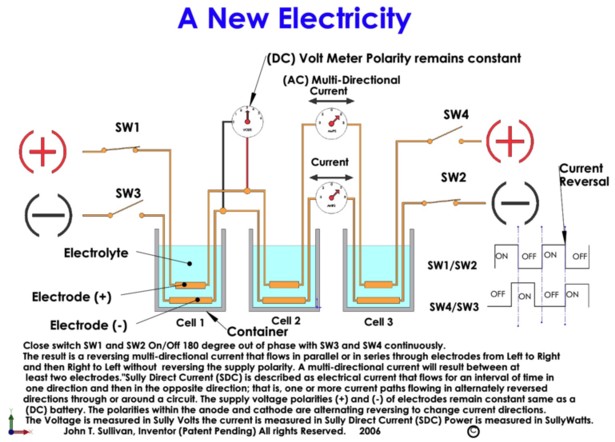
Increase the efficiency of electrolysis and other electrolytic processes by using multi-directional currents that reverse direction without swapping supply polarity.
Problem
Low hydrogen production rates and electrode scaling in conventional water electrolysis caused by bubble adhesion and fixed current direction.
Concept Summary
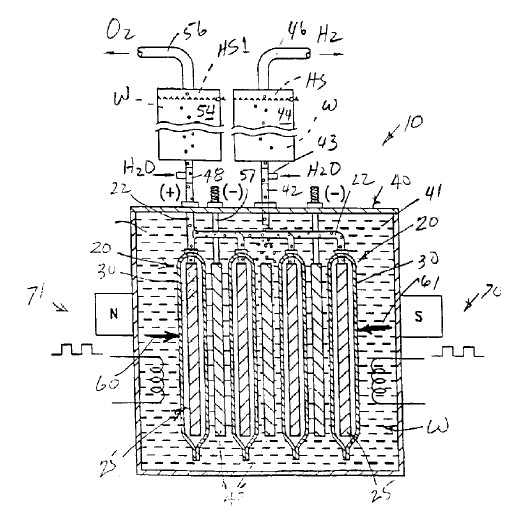
The invention generates multi-directional electrical currents by cyclically reversing the direction of a conventional current applied to one or more electrodes while keeping the supply polarity constant. The resulting EMF pulses cause the current in the medium to reverse direction, producing alternating magnetic fields and mechanical vibrations that shear water molecules and detach gas bubbles, thereby improving electrolysis efficiency and other processes.
Principles
- Cyclic reversal of current direction within electrodes
- EMF pulse propagation
- Magnetic field reversal
- Resonant vibration of electrodes
- Shearing forces on electrolytic bubbles
Scientific Domains
Materials
- Metal electrodes
- Water electrolyte
Mechanisms of Action
- Directional current reversal without changing supply polarity
- Multidirectional magnetic forces on electrodes and ions
- Mechanical shaking of electrodes via resonant circuits
- Shearing of water molecules to improve bond breakage
Energy Sources
Applications
- Water electrolysis for hydrogen production
- Battery and capacitor life extension
- Electromagnetic projectile launchers
- Cold cathode lighting
- Water purification
Claimed Performance
Significantly increased hydrogen production efficiency and reduced electrode scaling during water electrolysis.
Limitations
- No quantitative performance data provided
- Requires specific electrode geometry and resonant circuitry
- Scalability to industrial levels not demonstrated
Red Flags
- Claims are not supported by peer-reviewed data
- Broad, unverified statements about many unrelated applications