Goal
Increase the efficiency of electrical generators and achieve over-unity (free-energy) output.
Problem
Low conversion efficiency, magnetic flux distortion, and the need for commutators in conventional DC generators.
Concept Summary
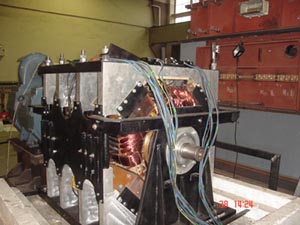
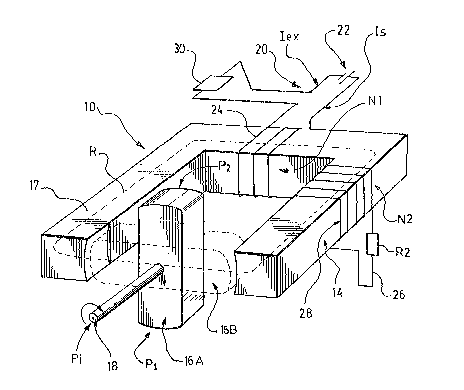
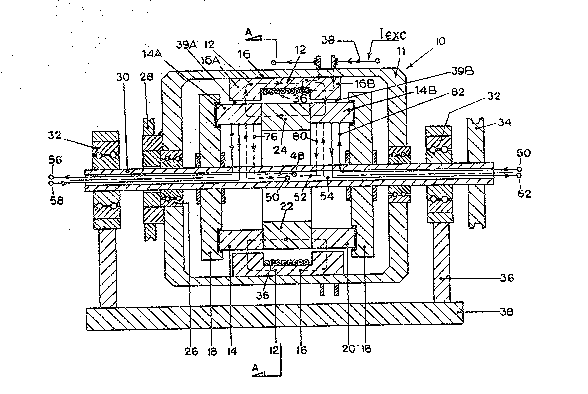
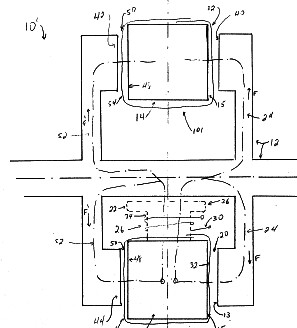
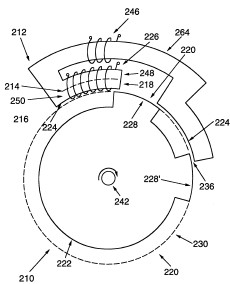
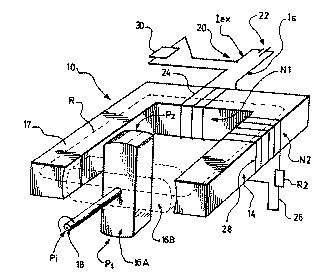
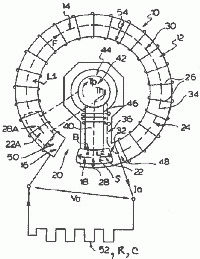
An asymmetrical electro-mechanical device in which a geometrically-magnetically-asymmetrical stator and rotor move relative to each other across an air gap. The magnetic flux path is interrupted at the gap, inducing voltage in armature conductors on both stator faces. Variants include correction coils to cancel unwanted flux, commutator-less DC operation, and multiple interchangeable stator/rotor units to improve efficiency.
Detailed Description
The invention comprises a stator with an air gap that makes it magnetically asymmetrical and a rotor that passes by this gap. When the rotor moves, the magnetic flux linking the stator is periodically interrupted, generating an EMF in conductors placed on both stator faces. One embodiment adds a correction coil wound around a portion of the magnetic circuit; a correction current creates an opposing magnetic flux that reduces distortion and load effects, thereby raising efficiency. Other embodiments describe a commutator-less DC machine where the rotor and stator move relative to each other, eliminating the need for brushes. The patents also claim methods of increasing generator efficiency by adjusting reluctance, supplying reactive current, and filtering DC components from counter-potentials.
Principles
- Electromagnetic induction
- Reluctance modulation
- Flux asymmetry
- Reactive current compensation
- Correction coil flux cancellation
Scientific Domains
Materials
- Ferromagnetic core material
- Copper windings
- Permanent magnets or electromagnets
- Insulating epoxy
Mechanisms of Action
- Relative motion between rotor and stator across an air gap
- Interruption of magnetic flux causing induced voltage
- Use of correction coil to generate opposing magnetic flux
- Elimination of commutation by DC current flow in armature conductors
Energy Sources
Applications
- Alternative power generation
- Renewable-energy supplement
- Low-cost electricity for remote sites
Claimed Performance
Over-unity (free-energy) generation and efficiency improvements over prior art electro-mechanical devices.
Experimental Evidence
Unconfirmed claims; no quantitative data or peer-reviewed experiments provided in the article.
Replication Status
Not reported; the article lists patents but no independent replication.
Limitations
- No peer-reviewed experimental data
- Claims of over-unity conflict with conservation of energy
- Potential for unverified or fraudulent performance
Red Flags
- Over-unity / free-energy claim without supporting data
- Privacy removal request suggesting possible concealment
- Multiple patents with similar abstracts but no disclosed testing