Goal
Transmit multiple independent radio channels on the same carrier frequency by encoding them in different orbital angular momentum (OAM) states.
Problem
Severe congestion of the wireless radio spectrum limiting data capacity for TV, radio, Wi-Fi and cellular services.
Concept Summary
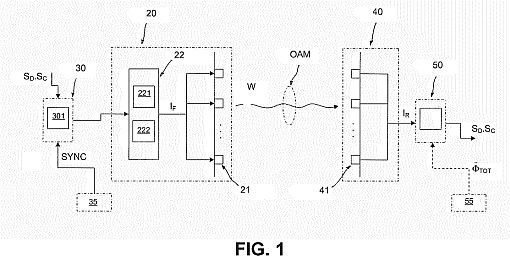
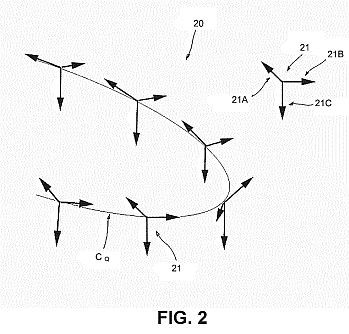
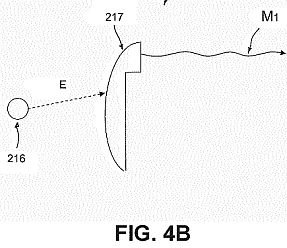
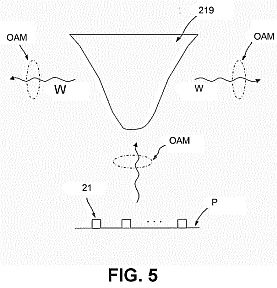
The invention uses a modified parabolic reflector to generate radio beams that carry orbital angular momentum (OAM). By creating a phase-twist (vortex) in the transmitted beam, each OAM mode becomes an orthogonal communication channel that can be received and demodulated with a simple interferometric Yagi-Uda antenna pair. Two channels (l = 0 and l = 1) were experimentally demonstrated over a 442 m link at 2.414 GHz, proving the feasibility of multiplexing many channels on a single frequency.
Detailed Description
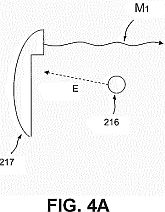
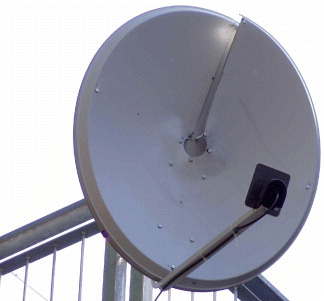
Two identical 2 W Wi-Fi transmitters were fed into a standard 16.5 dBi Yagi-Uda antenna (l = 0) and a mechanically modified 26 dBi off-axis parabolic antenna (l = 1) whose reflector was cut and twisted to create a helical phase front. The two beams were transmitted simultaneously on the same 2.414 GHz carrier. At the receiver, two identical Yagi-Uda antennas were spaced and oriented to form an interferometer; a 180 deg phase-shifted cable combined their signals, allowing the phase-fingerprint of each OAM mode to be discriminated. The experiment measured a maximum received power of 30.7 dBm, video SNR of 38 dB and audio SNR of 45 dB, confirming that both channels were independently recovered.
Principles
- Orbital Angular Momentum (OAM) of electromagnetic waves
- Phase-multiplexing using helical wavefronts
- Interferometric phase discrimination
Scientific Domains
Materials
- Commercial off-axis parabolic antenna (metallic reflector)
- Yagi-Uda antenna (metallic elements)
- Standard RF coaxial cables
- Mechanical cutting tool for reflector modification
Mechanisms of Action
- Generation of OAM-encoded radio beams by mechanically twisting a parabolic reflector
- Spatial separation of OAM modes using phase-sensitive interferometer
- Decoding of independent data streams from orthogonal OAM states
Energy Sources
Applications
- High-capacity wireless communication (Wi-Fi, cellular, TV)
- Spectrum-efficient data links
Claimed Performance
Two orthogonal OAM channels transmitted simultaneously over 442 m with video SNR ~= 38 dB and audio SNR ~= 45 dB; the technique is theoretically extensible to an unlimited number of channels within a fixed bandwidth.
Experimental Evidence
Outdoor experiment in Venice (May 2012) using 2.4 GHz Wi-Fi band; measured received power 30.7 dBm, background noise -87 dBm, SNR values as above; phase-difference interferometer successfully discriminated l = 0 and l = 1 modes.
Replication Status
Single-team demonstration; no independent replication reported in the article.
Limitations
- Requires precise mechanical modification of parabolic reflectors
- Alignment sensitivity of receiving interferometer
- Demonstrated only for two OAM modes (l = 0, 1) and short-range line-of-sight