Goal
Provide a simple, high-power-to-weight rotary engine or pump that can operate on any fluid (steam, water, air, compressed gases) by exploiting fluid adhesion and viscosity.
Problem
Inefficient conventional turbines and pumps, low power-to-weight ratios, complex blade designs, and high manufacturing costs.
Concept Summary
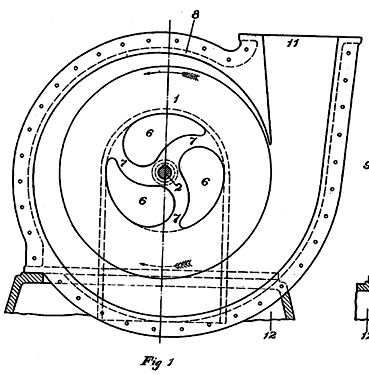
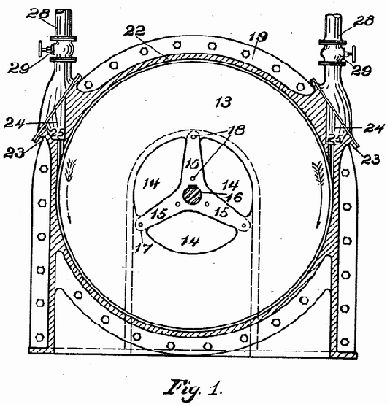
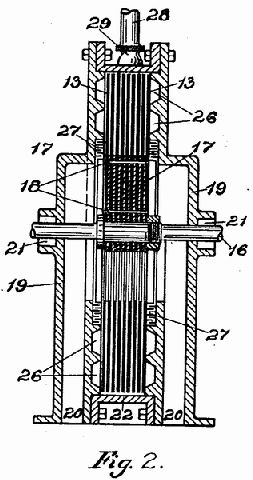
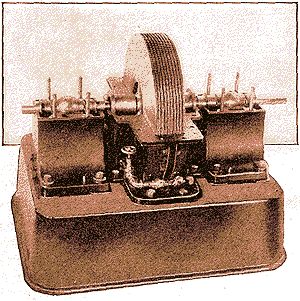
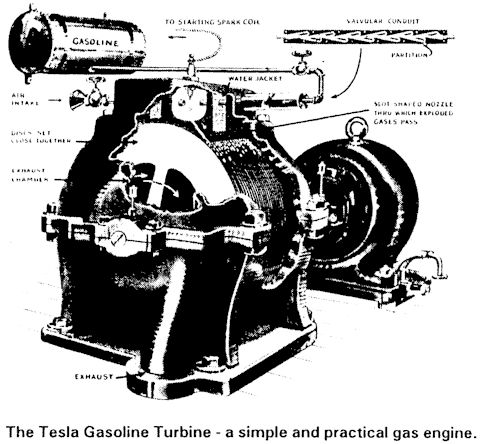
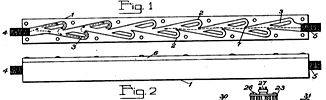
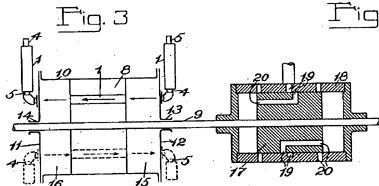
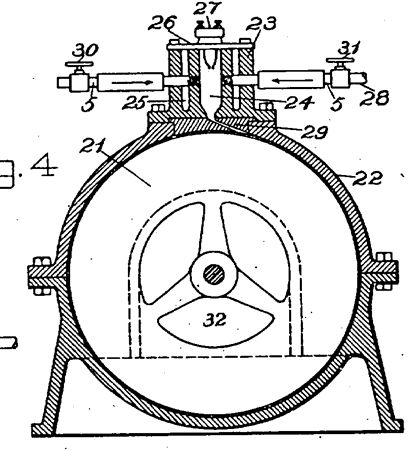
Tesla's disk turbine consists of a stack of smooth, flat metal disks mounted on a shaft. When the shaft rotates, the fluid in contact with the disks adheres to them and, because of viscosity, is dragged around the disk surface. This creates a boundary-layer drag that transfers torque from the fluid to the shaft (engine mode) or from the shaft to the fluid (pump mode). The same principle works with gases, liquids, or steam, and the device can be built with very few moving parts.
Detailed Description
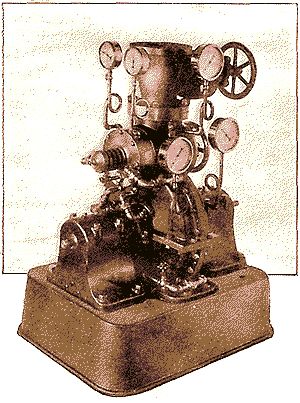
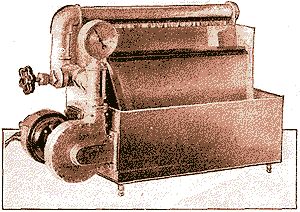
Tesla described a prototype with half a dozen disks, each less than three inches in diameter, driven by a small electric motor. When the disks rotated in air, a noticeable suction was felt at the center, indicating airflow from the inlet to the periphery. Enclosing the disks in a sealed case with a single inlet and outlet produced an air pump capable of moving ten thousand cubic feet of air per minute. A larger version with eight disks eighteen inches in diameter pumped four thousand gallons of water per minute to a height of 360 ft. An engine version using steam as the driving fluid, with nine-inch disks, generated 110 hp and could potentially double that output. The design relies solely on smooth disks-no vanes or blades-using the adhesion and viscosity of the fluid to create thrust or torque.
Principles
- Adhesion
- Viscosity
- Boundary-layer (skin) friction
- Fluid drag
Scientific Domains
Materials
- Steel
- Aluminum
- Water
- Steam
- Air
Mechanisms of Action
- Fluid adheres to rotating disks
- Viscous drag transfers momentum from fluid to shaft
- Pressure differential creates suction and discharge
- Conversion of fluid flow to rotational mechanical power
Energy Sources
Applications
- Power generation
- Water pumping
- Air compression
- Propulsion for aircraft
- Industrial machinery
Claimed Performance
Ten-thousand cubic feet of air per minute; four-thousand gallons per minute to 360 ft height; 110 hp from a nine-inch disk engine; up to twenty-five times the power-to-weight ratio of contemporary engines.
Experimental Evidence
Tesla demonstrated a pump delivering ten thousand cubic feet of air per minute, a water pump moving four thousand gallons per minute to 360 ft, and a steam-driven engine producing 110 hp with nine-inch disks.
Replication Status
Operational prototypes demonstrated in 1911-1912; several engines and pumps reported in operation at the New York Edison Company.
Limitations
- Precise disk spacing required
- Efficiency lower than optimized conventional turbines
- Material wear from high-speed rotation
- Scaling to very large power outputs not demonstrated
Red Flags
- Claims based on anecdotal demonstrations rather than peer-reviewed data
- No independent replication documented
- Potential overstating of power-to-weight ratio