Goal
Reduce fuel consumption and improve drivability by eliminating the torque converter and providing seamless, infinitely variable gear ratios.
Problem
Inefficiency and slippage of conventional torque converters and fixed-ratio automatic gearboxes that increase fuel use and limit hill-descent control.
Concept Summary
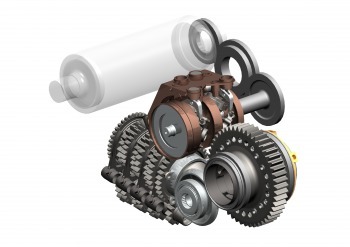
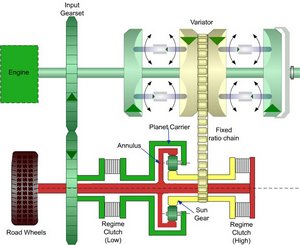
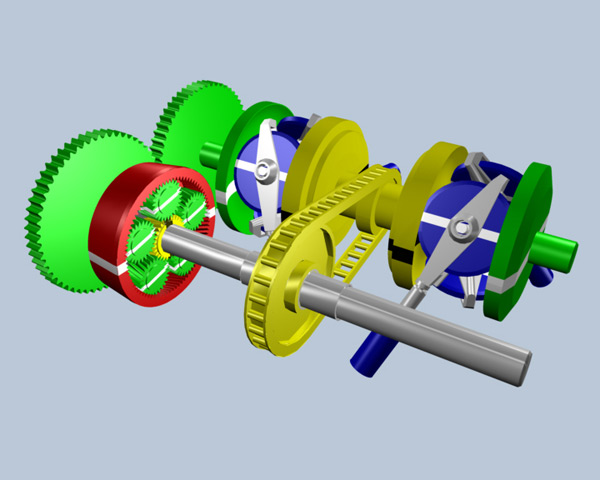
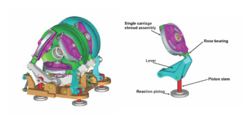
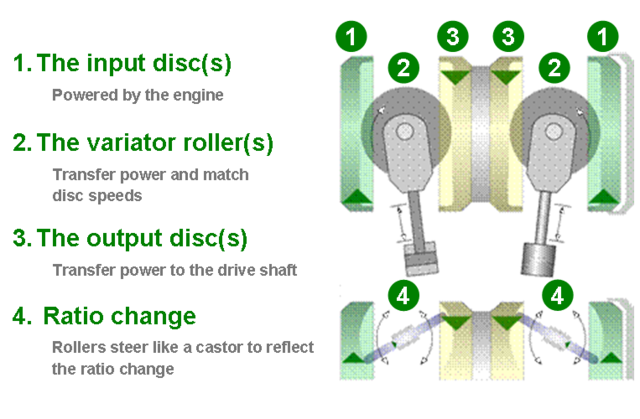
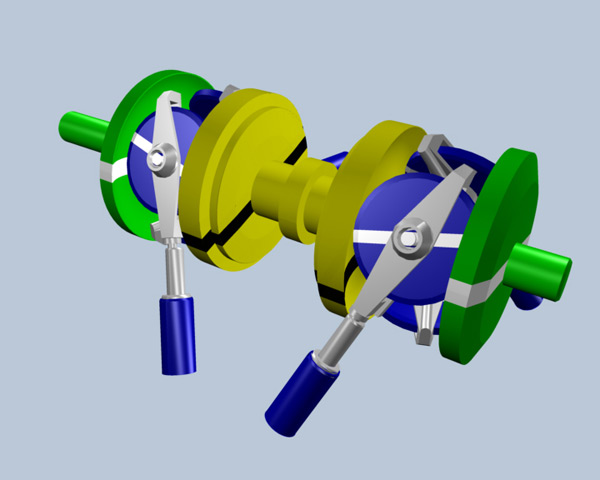
The Torotrak transmission replaces the fluid-coupled torque converter with a pair of clutches and variator discs that continuously adjust the gear ratio. A planetary gearset and software-controlled lockable clutches provide seamless power delivery, high over-drive ratios, and hill-descent braking without overheating.
Principles
- Infinitely variable transmission (IVT)
- Variator disc mechanism
- Planetary gearset
- Software-controlled clutch engagement
- Clutchless drive
Scientific Domains
Materials
- Steel discs
- Aluminum clutch plates
- Steel planetary gears
Mechanisms of Action
- Elimination of torque-converter slip
- Angle adjustment of variator discs to change ratio continuously
- Lockable clutches to select fixed ratios when needed
- Planetary gearset for torque multiplication and inversion
- Electronic control of gear selection and hill-descent mode
Applications
- SUVs
- Trucks
- Off-road vehicles
Claimed Performance
20% reduction in fuel consumption compared with conventional automatics; >91% transmission efficiency with ~1% slip; 70 mph achievable at 1000 rpm engine speed; seamless acceleration and precise hill-descent control.
Experimental Evidence
Statutory fuel-consumption tests on a Ford Expedition showed a consistent 20% improvement; test-drive reports described smooth operation, 25% grade hill-hold using reverse, and engine revs hovering around 1000 rpm at 70 mph; efficiency measured at >91% with 1% slip in pre-production units.
Replication Status
GM tested and approved the system; licenses granted to Getrag, Aisin AW, ZF Friedrichshafen, and other Tier-1 suppliers; several prototype SUVs have been evaluated by OEMs.
Limitations
- Requires precise mounting distance from engine
- Not yet in mass-production; still at prototype/early-production stage
- Dependence on software control for safety-critical functions