Goal
Extract usable energy from a free-flowing water stream without the need for a dam, by converting kinetic energy and depth-related potential energy into additional kinetic energy through a positive-feedback hydraulic arrangement.
Problem
Conventional hydroelectric plants require dams and can only capture a fraction of the kinetic energy of flowing water; the device aims to increase the extracted energy fraction and eliminate the need for large dam structures.
Concept Summary
A hydraulic turbine arrangement uses a positive-feedback loop between the inflow and outflow streams. Part of the kinetic energy of the incoming water is transferred to accelerate the downstream stream, creating a level difference (potential energy) that is then harvested. The theory claims that under certain flow conditions the output energy can be several times, even tens or hundreds of times, the kinetic energy of the incoming water.
Detailed Description
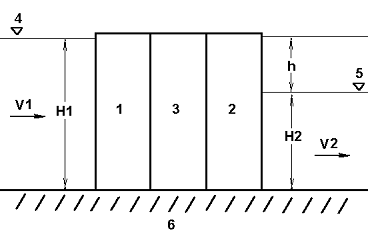
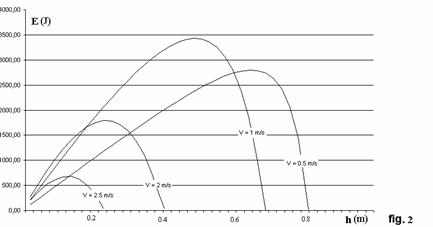
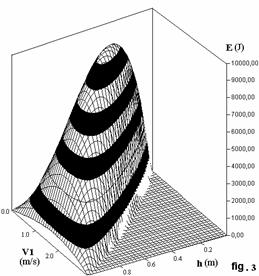
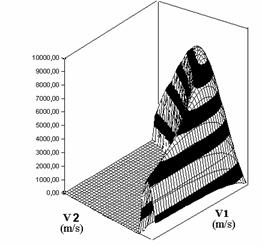
The device consists of working sections in the inflowing stream (1) and outflowing stream (2) linked by a feedback structure (3). Water enters at depth H1 and velocity V1, exits at a shallower depth H2 with higher velocity V2, creating a height difference h. Energy balance is expressed as E = Ep1 + Ek1 - Ek2, where the potential energy from the height difference and the kinetic energy of the inflow are combined to produce net output. Graphical analysis in the article shows an extremum where the power factor exceeds 1, suggesting self-acceleration of the flow.
Principles
- Positive feedback between inflow and outflow streams
- Conversion of kinetic energy to potential energy via level difference
- Hydraulic jump (energy dissipation and level equalisation)
- Exergy analysis
Scientific Domains
Materials
- Water
- Steel
Mechanisms of Action
- Kinetic energy extraction from upstream flow
- Acceleration of downstream flow using transferred energy
- Creation of a height (potential) difference between streams
- Harvesting of the resulting potential energy
Energy Sources
Applications
- Dam-free hydroelectric power generation
- Portable or remote power generation from rivers and streams
Claimed Performance
The device can produce several times the kinetic energy of the inflowing stream, and under certain conditions tens to hundreds of times more energy than the kinetic energy input.
Experimental Evidence
Engineers constructed a hydraulic turbine prototype and reported that it generated more energy than it was originally designed for, but no quantitative data or independent verification were provided.
Limitations
- Requires specific flow depth and velocity conditions
- Potential energy extraction limited by natural water column depth
- No independent experimental validation
Red Flags
- Claims of energy output exceeding input without rigorous data
- Lack of peer-reviewed or independently replicated results
- Possible misinterpretation of exergy and potential energy concepts