Goal
Enable an internal combustion engine to run on virtually any liquid or slurry fuel, reducing dependence on specific fuel properties and increasing the usable yield from crude oil.
Problem
Conventional spark-ignition and diesel engines require fuels with narrow property ranges (octane, cetane, volatility, viscosity), limiting the use of low-grade or alternative liquid fuels.
Concept Summary
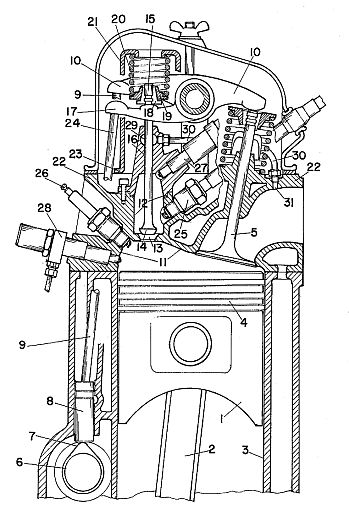
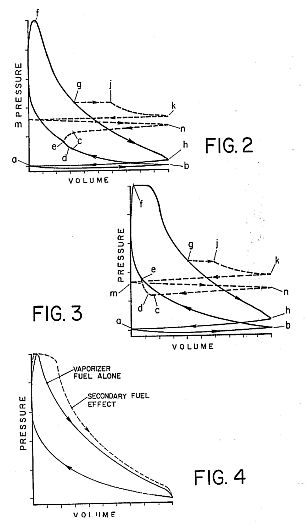
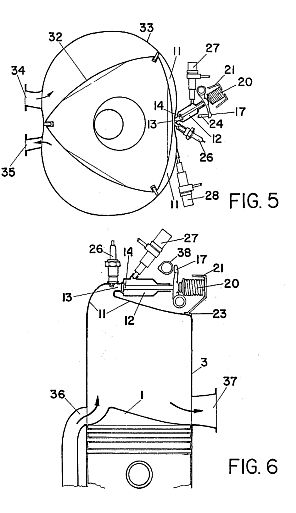
The invention adds a vaporizer chamber inter-connected with the main combustion chamber through a valve. Hot combustion products trapped in the vaporizer chamber pre-heat and vaporize injected liquid fuel. The vaporized fuel is then released into the main chamber during the compression stroke and ignited by a spark plug, producing a diffusion flame. This cycle allows the engine to accept any liquid fuel or slurry regardless of octane or cetane rating.
Principles
- Fuel vaporization using trapped hot combustion gases
- Compression-stroke ignition of vaporized fuel-air mixture
- Diffusion flame combustion
- Exhaust-gas recirculation for emission control
- Valve-timed fuel transfer
Scientific Domains
Materials
- Gasoline
- Diesel fuel
- Turpentine
- Aqueous alcohol
- Heating oil
- Coal slurry
- Water
Mechanisms of Action
- Inject liquid fuel into a heated vaporizer chamber where it absorbs heat from retained combustion products and vaporizes.
- Open vaporizer valve to release the high-pressure vaporized fuel into the main combustion chamber during compression.
- Ignite the vaporized fuel-air mixture with a spark plug, establishing a diffusion flame.
- Close vaporizer valve to trap hot gases, maintaining pressure for the next cycle.
Energy Sources
Applications
- Automobile engines
- Power generation plants
- Transportation vehicles
- Industrial engines
Claimed Performance
Engine can operate on gasoline, diesel, turpentine, aqueous alcohol, heating oil and slurry fuels without spark ignition, with low emissions and a reduction in petroleum consumption.
Experimental Evidence
Two prototype engines were built and successfully run with gasoline, diesel fuel, aqueous alcohol, heating oil, and turpentine.
Limitations
- Requires additional vaporizer chamber and valve hardware
- Heavy fuels may need pre-heating or longer residence time
- Complex valve timing and control
Red Flags
- Broad claim of "any liquid fuel" may be overstated without extensive testing
- No independent verification or peer-reviewed data provided