Goal
Produce useful perpetual motion for utility purposes.
Problem
Provides a continuous, free-energy source without the need for conventional fuel or external power input.
Concept Summary
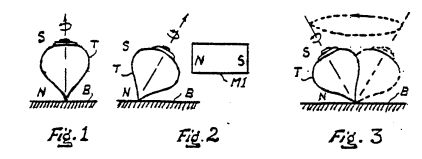
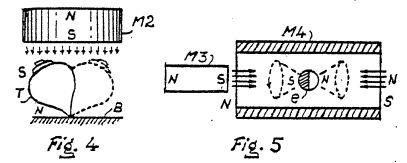
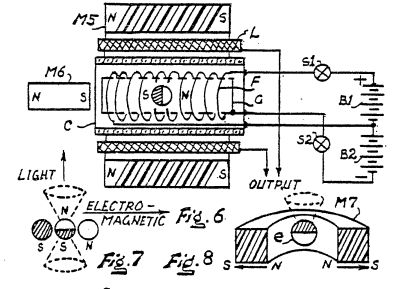
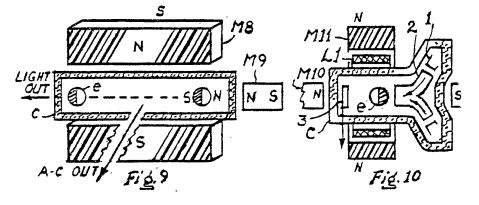
The invention combines the intrinsic spin energy of electrons with the static energy of permanent magnets. Electrons emitted from a heated filament are trapped in the magnetic field of a cylindrical permanent magnet. A second permanent magnet tilts the trapped electron beam, causing the electrons to precess (wobble). This precessional motion radiates a coherent electromagnetic field that can be harvested by a coil to produce electric power, allegedly indefinitely.
Detailed Description
A cylindrical vacuum chamber contains a heated filament that emits electrons. The chamber is placed inside the central field of a cylindrical permanent magnet (M5) which compresses the electrons into a beam and traps them permanently when the filament current is switched off. A second magnet (M6) of opposite polarity tilts the electron beam, inducing gyroscopic precession. The precessing electrons emit quadrature-phased electromagnetic radiation perpendicular to their polar axes. A coil (L) positioned between the magnet and the chamber captures this radiation and converts it to usable electric power (DC after rectification). The system claims to operate perpetually because the electron spin is considered a permanent energy source.
Principles
- Electron intrinsic spin as a static energy source
- Magnetic trapping of charged particles
- Gyroscopic precession (precessional resonance)
- Coherent electromagnetic radiation from precessing dipoles
- Energy conversion via inductive coupling
Scientific Domains
Materials
- Ferromagnetic material (permanent magnet core)
- Copper (coil winding)
- Tungsten (filament)
- Steel (vacuum chamber housing)
- Glass (vacuum chamber window)
Mechanisms of Action
- Electron emission and magnetic confinement
- Magnetically induced tilt and precession of electron beam
- Radiation of electromagnetic waves from precessing electrons
- Inductive capture of radiation by a coil
Energy Sources
Applications
- Electric power generation
- Coherent light source
- Wireless power transmission
Claimed Performance
High-power output claimed with perpetual operation; no quantitative figures provided.
Experimental Evidence
The article describes observed examples, laboratory tests, and references to electron spin resonance and nuclear magnetic resonance, but no measured data, repeatable experiments, or independent verification are presented.
Limitations
- No quantitative performance data
- Requires high-vacuum chamber and precise magnetic alignment
- Relies on unproven claim of permanent electron spin energy
- No independent replication reported
Red Flags
- Perpetual motion claim violates conservation of energy
- Lack of peer-reviewed experimental data
- Potential for fraudulent or pseudoscientific promotion