Goal
Increase heat-transfer efficiency while reducing pressure drop and energy consumption in industrial heat-exchanger systems.
Problem
Traditional shell-and-tube or coil heat exchangers require large material volumes and incur high pressure-drop losses, leading to excessive energy use.
Concept Summary
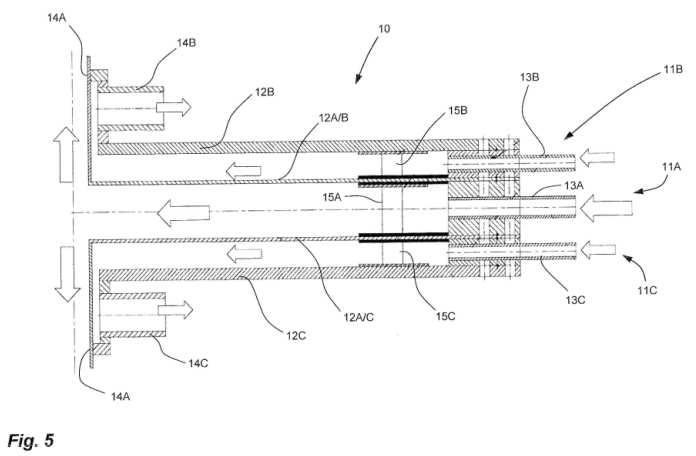
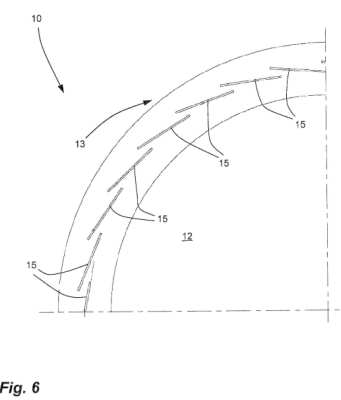
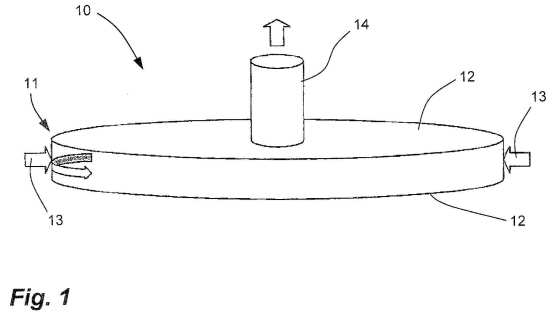
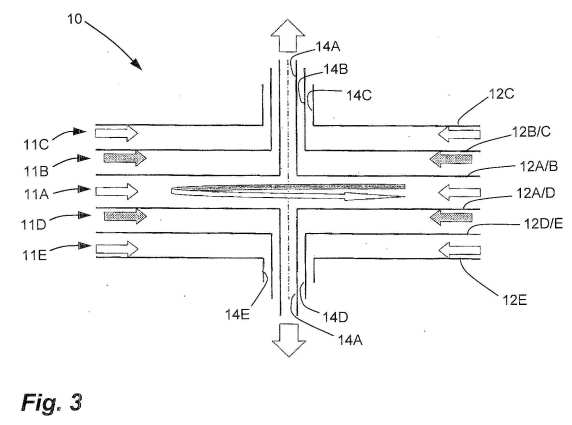
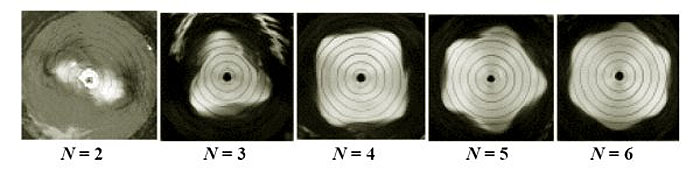
A disk-type heat exchanger where the fluid flows in a swirling (vortical) pattern between two spaced plates. Radial tangential inlets and a centrally positioned outlet create a vortex that enhances convective heat transfer and reduces frictional pressure loss.
Detailed Description
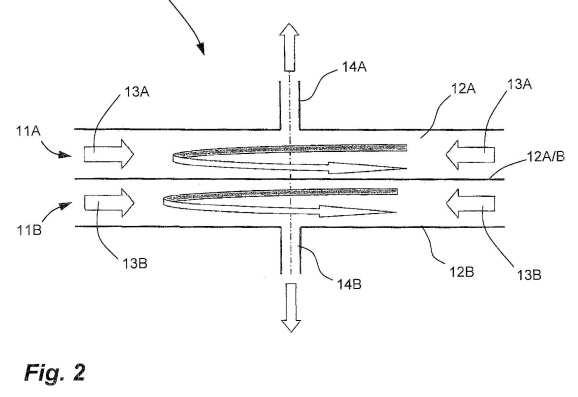
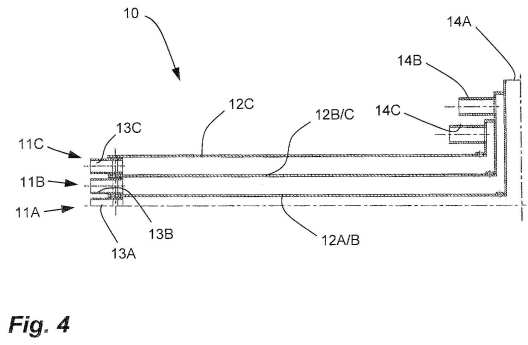
The invention replaces conventional tubes with a pair (or stack) of disks separated by a gap. A curved peripheral wall defines the gap; radially placed tangential inlets inject the primary fluid, which circulates in a vortex before exiting through a central outlet. Vanes and annular plates may be added to guide the flow. Multiple stages can be stacked, allowing two fluids to exchange heat across the disk surfaces. The disks are preferably made of high-conductivity metal such as aluminum.
Principles
- Vortex (swirling) flow
- Enhanced convective heat transfer
- Pressure-drop reduction
- Radial-tangential inlet geometry
- Curved peripheral wall guiding
Scientific Domains
Materials
- Aluminum
- Metal (general conductive plates)
- Vaned inserts
- Annular plates
Mechanisms of Action
- Swirling flow increases turbulence and reduces thermal boundary layer thickness
- Curved peripheral wall creates a circular flow path
- Radial tangential inlet imparts angular momentum to the fluid
- Central outlet allows accelerated flow and short residence time
Energy Sources
Applications
- Industrial refrigeration
- Power-plant heat recovery
- Petroleum refinery heating/cooling
- HVAC systems
Claimed Performance
Prototype demonstrated 40 x greater heat-transfer efficiency than a traditional heat-exchanger model.
Experimental Evidence
The article reports that a prototype built with the vortex-flow design achieved a forty-fold increase in efficiency, though no quantitative data or peer-reviewed validation is provided.
Replication Status
Prototype demonstrated
Limitations
- Requires precise manufacturing of curved peripheral walls and vanes
- Dependence on external pump power
- Potential fouling in the narrow gap
- Scale-up to large industrial units not yet demonstrated