Goal
Significantly increase fuel mileage and reduce emissions of internal combustion engines.
Problem
Low thermal efficiency of gasoline engines (~=25 % or less) and high fuel waste/emissions.
Concept Summary
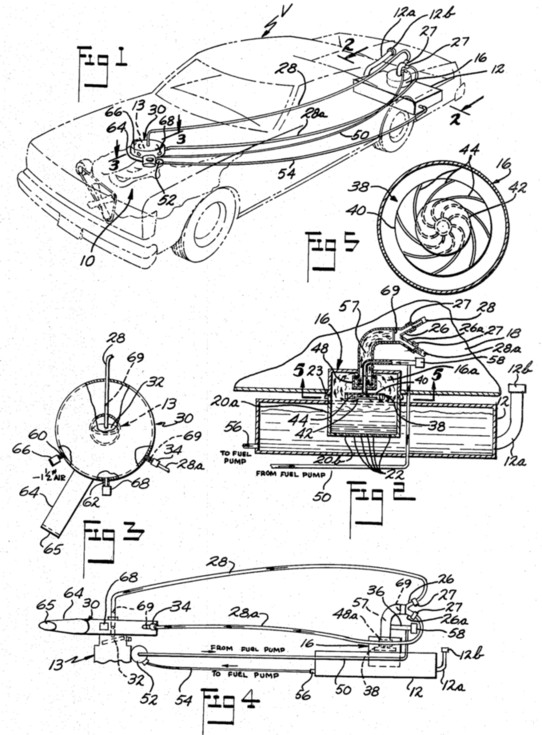
The VGAS converts liquid gasoline into a vapor-air mixture using an auxiliary fume tank, vacuum suction, and microprocessor-controlled temperature and flow regulation. The vapor fuel is supplied to the engine, aiming to improve combustion efficiency and double vehicle mileage.
Detailed Description
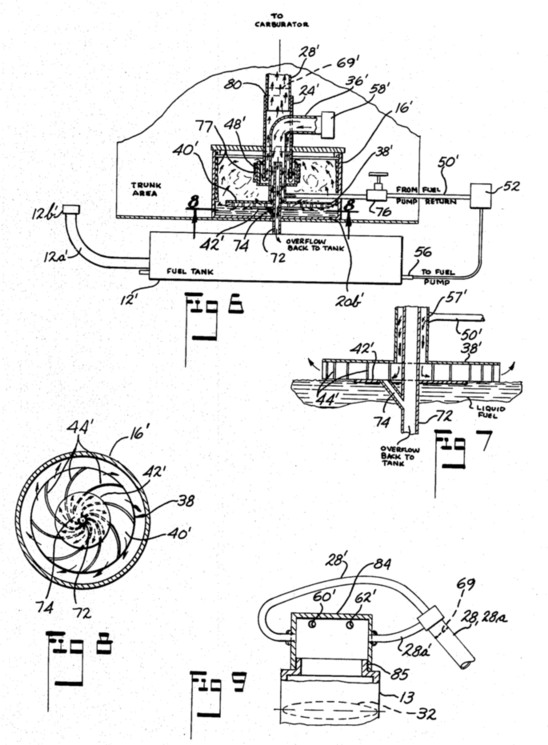
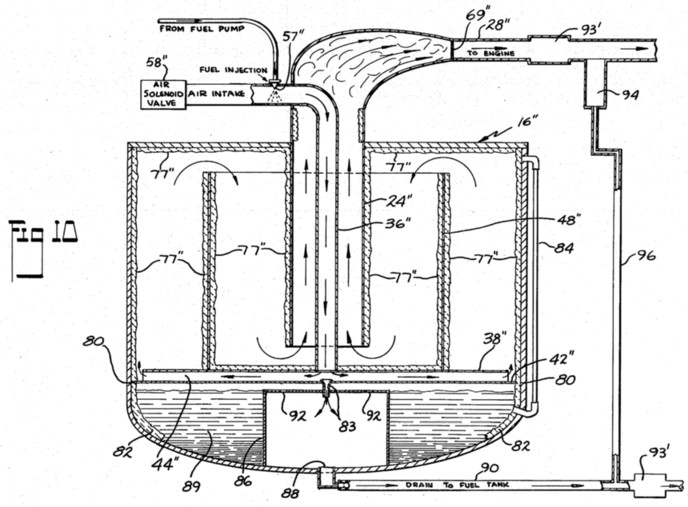
The system consists of a main liquid fuel tank, an auxiliary fume tank where fuel is vaporized, diffusion vanes and baffles to remove droplets, and a microprocessor that monitors engine demand and controls temperature and vacuum passageways. The vapor-fuel mixture is fed to the carburetor (or directly to the intake) while the engine's vacuum assists fuel delivery. The device weighs about 31 lb, retails for $400-$500, and can be installed in 2-3 hours. Field testing on a 1975 Cadillac reported 45-48 mpg, claimed to be up to 400 % greater than conventional liquid-fuel operation.
Principles
- Fuel vaporization
- Vacuum-assisted fuel delivery
- Microprocessor demand control
- Diffusion and droplet removal
Scientific Domains
Materials
- gasoline
- air
Mechanisms of Action
- Liquid gasoline is heated and mixed with air in a fume tank to create a combustible vapor
- Engine vacuum draws the vapor-air mixture toward the carburetor
- A microprocessor continuously adjusts temperature and flow based on engine load
- Diffuser vanes and baffles separate liquid droplets, ensuring a uniform vapor mixture
Energy Sources
Applications
- automotive vehicles
- marine engines
- stationary generators for irrigation or electrical generation
Claimed Performance
100 % gain in fuel mileage, potential doubling of mileage, up to 400 % greater mileage (45-48 mpg on a 1975 Cadillac compared to typical lower values).
Experimental Evidence
Testing on a 1975 Cadillac yielded a mileage of 45-48 mpg, described as "the order of at least 400 percent greater than that which has been heretofore obtainable using liquid gasoline".
Replication Status
Field tested by approximately 330 US dealer-installers; no independent peer-reviewed replication reported.
Limitations
- Performance claims rely on limited field testing
- Requires precise microprocessor control and temperature management
- Potential compatibility issues with modern fuel-injection systems
- No published emissions compliance data
Red Flags
- Extraordinary mileage increase (400 %) without independent verification
- Lack of peer-reviewed data or third-party testing
- Potential for marketing hype rather than proven technology