Goal
Provide optimum maneuverability and high efficiency for ship propulsion.
Problem
Need for a ship propulsion system that can generate thrust in any direction and steer quickly without changing rotation speed.
Concept Summary
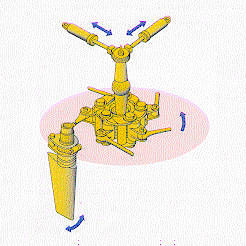
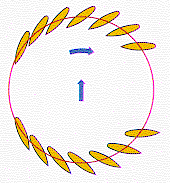
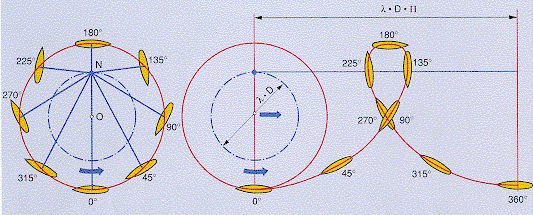
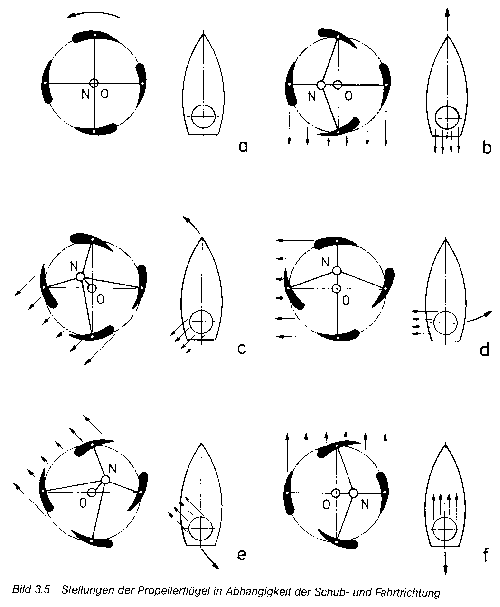
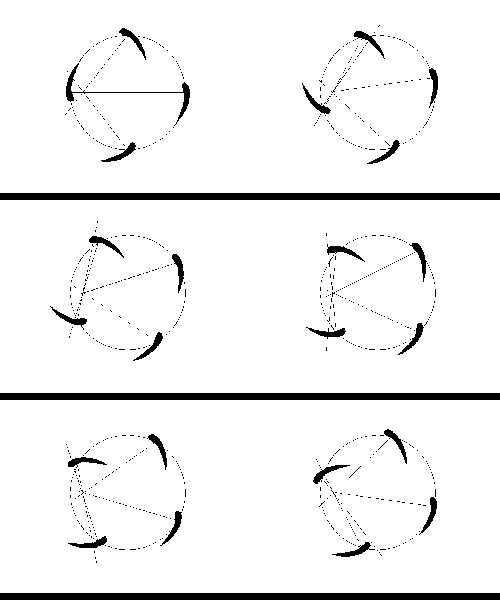
The Voith-Schneider Propeller uses cycloidal propulsion: a set of vertical blades rotate constantly about a central axis while their pitch is varied by moving a control point (N) off-center. This creates an oscillatory motion that produces thrust in any desired direction, giving the vessel instant steering and high thrust efficiency.
Detailed Description
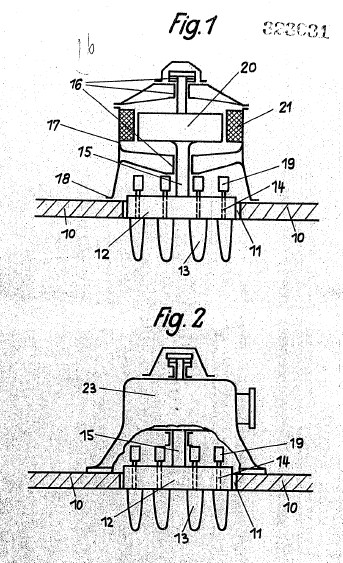
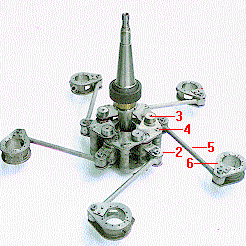
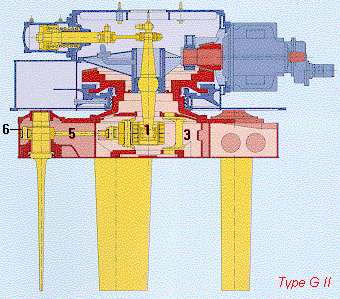
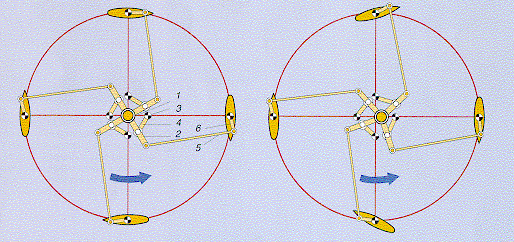
Blades are attached to a rotating hub; a non-rotating control point N moves radially, changing the blade angle during each revolution. The blade tip follows a cycloidal path, generating thrust whose magnitude depends on the oscillation amplitude and whose direction is set by the phase correlation. The mechanism includes a spherical bush, link, bearing pin, crank, connecting rod, and actuating lever, driven hydraulically or mechanically.
Principles
- Cycloidal motion
- Hydrodynamic thrust generation
- Variable blade pitch (kinematics)
- Hydraulic actuation
Scientific Domains
Mechanisms of Action
- Rotating hub with vertical blades
- Oscillating blade pitch via control point N
- Cycloidal blade tip trajectory
- Hydraulic or mechanical linkage to set blade angle
Energy Sources
Applications
- Ship propulsion
- Marine vessels
- Maneuverable craft
- Underwater vehicles
Claimed Performance
Excellent maneuverability and high efficiency; thrust can be directed to any angle between 0 deg and 360 deg .
Experimental Evidence
Manufacturer documentation, illustrative diagrams, and description of the mechanical kinematics are provided; no quantitative performance data are given in the article.
Limitations
- Mechanical complexity
- Wear of moving linkages
- Higher manufacturing cost compared with simple propellers
- Requires precise hydraulic control