Goal
Create a silent, highly efficient aircraft propeller that reduces noise and increases thrust compared with conventional propellers.
Problem
Conventional propellers generate significant noise and have limited aerodynamic efficiency.
Concept Summary
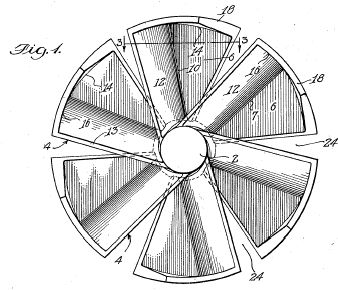
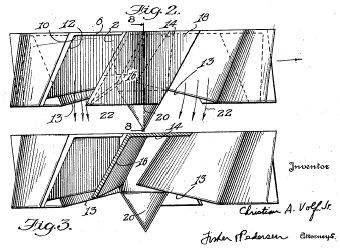
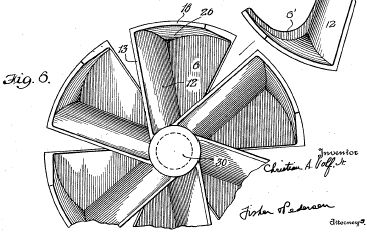
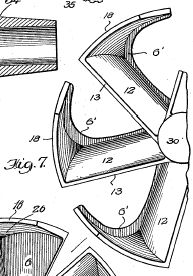
Volf's design replaces a traditional propeller blade with a three-part blade consisting of a flat back portion, an angled impeller portion, and a cylindrical flange. The flange prevents radial fluid escape and forces the displaced air or water to exit directly rearward, partly converging toward the rotation axis. This arrangement is claimed to produce a suction-plus-pressure thrust mechanism that is both silent and more efficient than standard propellers.
Detailed Description
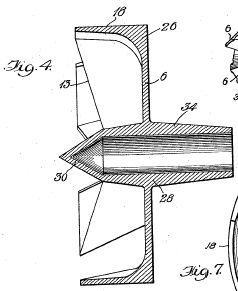
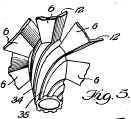
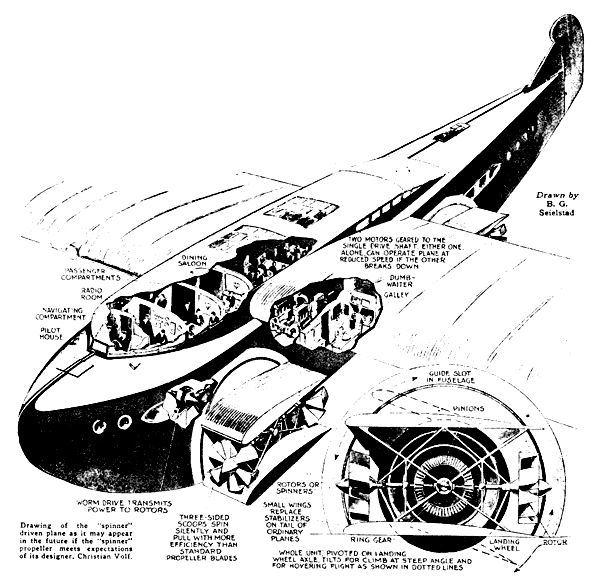
The rotor comprises a hub from which multiple blades radiate. Each blade has a flat back portion perpendicular to the axis, an angled impeller portion that accelerates fluid rearward, and a flange shaped as a segment of a cylinder that is substantially perpendicular to the blade faces. The flange directs the fluid straight rearward and prevents lateral escape. A conical cap at the delivery side prevents eddying, while a concave extension with optional spiral grooves on the intake side guides fluid into the blade spaces. In operation, fluid enters between blades, is straightened and accelerated by the impeller surfaces, and is expelled rearward, creating reactive thrust. The design can be used as a pump, air mover, or aircraft propeller, and multiple rotors may be stacked or run in series, possibly in opposite directions.
Principles
- Newton's third law (reaction thrust)
- Fluid dynamics - rearward acceleration of fluid
- Pressure differential and suction
- Flow redirection via cylindrical flange
Scientific Domains
Mechanisms of Action
- Rearward fluid acceleration
- Suction-plus-pressure thrust generation
- Prevention of radial fluid escape with flange
- Reduction of eddies via rounded blade corners and conical cap
Applications
- Aircraft propulsion
- Water pumping
- Air moving devices
- Superchargers
Claimed Performance
Silence in operation and thrust efficiency far surpassing that of standard propellers; capable of supporting an airplane with practically no wing.
Experimental Evidence
Volf tested the propeller in a tank of goldfish; the fish were unharmed as they were sucked through the blades, unlike with a conventional marine propeller. He also reported that the rotor was silent when spun in air and that its tractive force on models was "amazing".
Limitations
- No quantitative performance data provided
- Only small-scale laboratory tests described
- Manufacturing complexity of the flange and blade geometry not addressed
- Unclear scalability to full-size aircraft