Goal
Provide a rapid, inexpensive, and durable construction material for low-cost housing, especially for impoverished populations.
Problem
Lack of affordable, sturdy housing; need for fast construction methods; high cost and environmental impact of conventional concrete; waste encapsulation.
Concept Summary
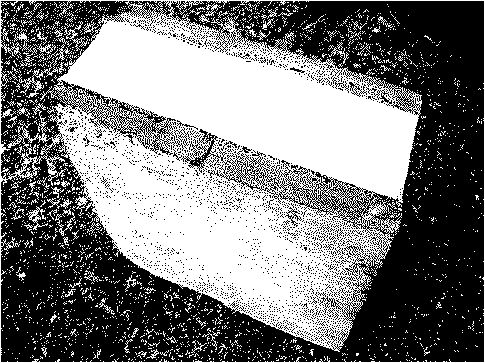
Grancrete is a spray-on, room-temperature-setting ceramic coating made from a locally available mix of sand or sandy soil, ash, magnesium oxide and potassium phosphate. Applied to a lightweight frame such as Styrofoam, it hardens within minutes to form a fire-resistant, temperature-stable, and structurally strong surface that can be used to build entire dwellings quickly and cheaply.
Principles
- Chemically bonded phosphate ceramics
- Room-temperature setting reaction
- Spray-on application of slurry
- Use of magnesium oxide and potassium phosphate as binder
Scientific Domains
Materials
- sand
- sandy soil
- ash
- magnesium oxide
- potassium phosphate
- water
- styrofoam (polystyrene)
- poly(acrylic acid)
- acrylate
Mechanisms of Action
- Phosphate ceramic reacts with magnesium oxide to form a hard, chemically bonded matrix
- Water acts as a medium for the slurry, evaporating to cure the coating
- Adhesion to polystyrene (Styrofoam) provides structural integration
Applications
- Affordable housing for low-income communities
- Rapid-deployment disaster-relief shelters
- Low-cost modular construction
- Encapsulation of hazardous waste (original Ceramicrete use)
Claimed Performance
Stronger than conventional concrete, fire-resistant, withstands tropical and sub-freezing temperatures, cures in ~15 minutes, cost ~= $6,000 per home, greenhouse-gas emissions ~1/10 of concrete.
Experimental Evidence
Argonne National Laboratory and Casa Grande have field-tested Grancrete for structural properties, post-application behavior and production costs. Experiments proved it is stronger than concrete, fire-resistant and temperature-stable. A test house is being built in India.
Replication Status
Field-tested by Argonne and Casa Grande; prototype test house under construction in India; no commercial scaling reported.
Limitations
- Requires a polymeric frame (e.g., Styrofoam) for adhesion
- Performance under seismic and hurricane loads still untested
- Dependence on supply of magnesium oxide and potassium phosphate
- Long-term durability data limited
Red Flags
- Potential overstating of performance without independent peer-reviewed data