Goal
Recover uranium and other transuranic metals from radioactive ash and contaminated soils.
Problem
Radioactive waste containing transuranic contamination (ash, incinerator residues, soils).
Concept Summary
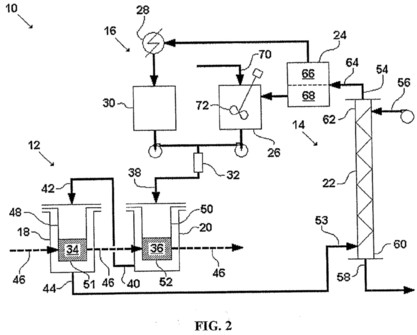
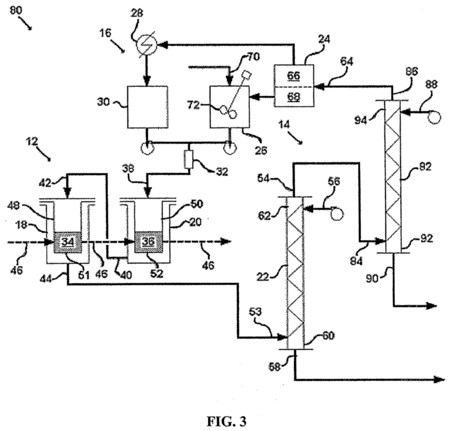
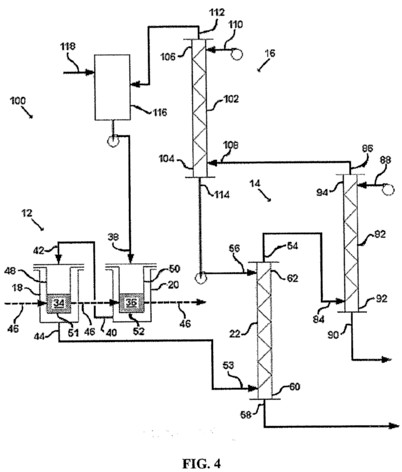
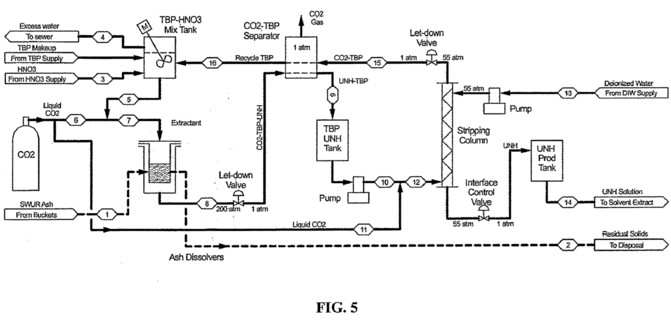
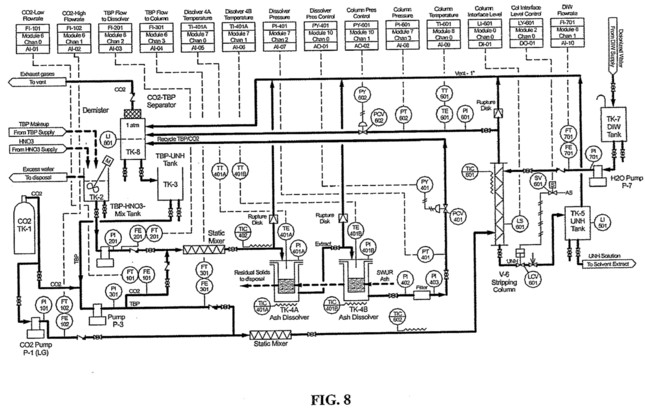
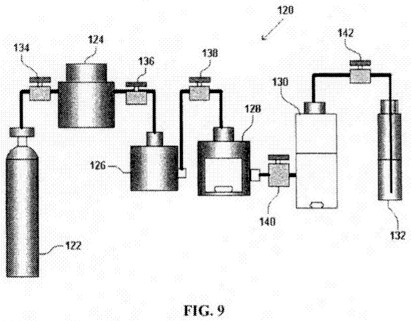
A supercritical carbon-dioxide (CO_2) extraction process in which a chemical ligand is added to bind uranium, plutonium and other metals. The supercritical CO_2 carries the metal-ligand complexes out of the waste matrix; pressure reduction releases the metals, and the ligand/solvent can be recycled.
Detailed Description
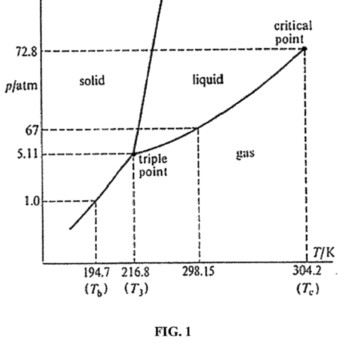
The process uses supercritical CO_2 (~=6.9 MPa, 31 deg C) as a green solvent. A ligand (complexing agent) that selectively binds actinides is mixed with the waste (incinerator ash or contaminated soil). The supercritical CO_2 flows through the waste, dissolving the ligand-metal complexes. After extraction, the CO_2 is depressurized to a gas, leaving the metal-ligand complexes behind. A counter-current stripping column with a stripping agent separates the metal from the ligand, allowing the ligand and CO_2 to be recycled. The method has been demonstrated on 32 t of ash at Richland, WA, and in laboratory soil tests achieving up to 80 % plutonium extraction.
Principles
- Supercritical fluid extraction
- Ligand complexation of actinides
- Counter-current stripping
- Pressure-induced solvent recovery
Scientific Domains
Materials
- Carbon dioxide (CO_2)
- Ligands / complexing agents
- Oxidizing agents
- Acid/base reagents
- Uranium-containing ash
- Plutonium-spiked soil
Mechanisms of Action
- Supercritical CO_2 dissolves ligand-metal complexes
- Ligand selectively binds uranium, plutonium, etc.
- Pressure drop releases metals from the solvent
- Stripping agent separates metals from ligand
Energy Sources
Applications
- Nuclear fuel recycling
- Radioactive waste remediation
- Material recovery from incinerator ash
Claimed Performance
Plutonium extraction efficiencies 14-19 % in first run, 60-80 % after parameter adjustment; recovery of ~2 t of uranium from 32 t of ash (~=$6 M value).
Experimental Evidence
Laboratory soil extractions showed up to 80 % plutonium removal; pilot-scale plant planned to process 32 t of ash at Richland, WA; first industrial demonstration announced in 2008.
Replication Status
First full-scale demonstration planned with AREVA on 32 t of ash; no independent replication reported.
Limitations
- Requires high-pressure equipment
- Ligand synthesis and recovery costs
- Regulatory approvals for handling actinides
- Scalability to large waste streams