Goal
Reduce methane emissions from ruminants and improve animal growth and milk/meat quality.
Problem
Methane emissions from livestock (ruminants) contribute significantly to greenhouse-gas emissions and represent an energy loss for the animal.
Concept Summary
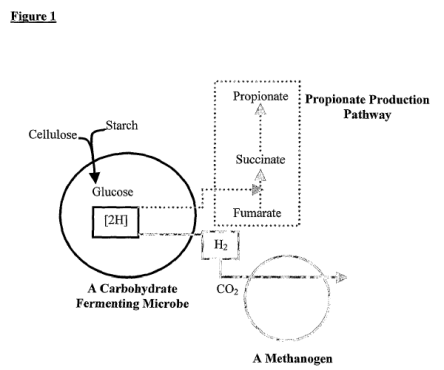
The invention uses encapsulated fumaric acid (or its salts) as a feed additive for ruminants. The organic acid acts as a hydrogen sink in the rumen, diverting reducing equivalents away from methanogenic archaea and toward propionate formation, thereby decreasing methane production. Encapsulation provides a slow-release profile that avoids a drop in rumen pH and improves palatability.
Principles
- Hydrogen competition with methanogens
- Slow-release encapsulation
- Rumen pH stabilization
Scientific Domains
Materials
- Fumaric acid
- Potassium fumarate
- Sodium fumarate
- Partially hydrogenated vegetable oil (lipid coating)
- Polyethylene glycol
- Polyvinyl pyrrolidone
- Cellulose-based polymers
- Hydroxyalkyl carboxylate polyester
Mechanisms of Action
- Fumaric acid acts as an alternative hydrogen acceptor, reducing H_2 availability for methanogenesis
- Encapsulation delays acid release, maintaining rumen pH above 6
- Increased propionate formation redirects carbon flow
Applications
- Livestock methane emission reduction
- Improved animal growth rates
- Enhanced milk and meat production
Claimed Performance
Methane production reduced by up to 70 % in lamb trials; faster weight gain observed; no undesirable rumen pH drop when acid is encapsulated.
Experimental Evidence
In vitro and in vivo studies (Figures 1-10) showed up to 70 % reduction in methane production in lambs and increased propionate concentrations; encapsulated fumaric acid maintained rumen pH above 6.
Replication Status
No independent replication reported in the article.
Limitations
- Potential rumen pH drop with non-encapsulated acids
- Cost and scalability of encapsulation process
- Need for precise dosing to avoid feed palatability issues
Red Flags
- Claims of up to 70 % reduction are based on limited trial data; no large-scale field trials reported