Confidence
0.90
Practicability
0.70
Evidence
0.30
Fringe Score
0.20
Risk
0.20
TRL
5
Goal
Create a radar system that is virtually undetectable by resembling random noise while still detecting objects.
Problem
Conventional radar signals can be detected and jammed; they also interfere with existing communication bands.
Concept Summary
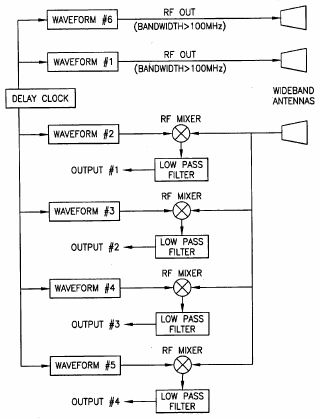
The system transmits a very low-intensity, ultra-wideband RF signal whose waveform is pseudorandom or random. Because the signal looks like background noise, standard receivers filter it out, making the radar hard to detect. Reflections from targets are captured and processed to extract object information.
Principles
- Pseudorandom/Random waveform transmission
- Ultra-wideband low-power signal
- Signal-to-clutter optimization
Scientific Domains
Mechanisms of Action
- Transmit low-power broadband RF noise
- Receive reflected noise from targets
- Correlate received signal with known pseudorandom pattern to detect objects
Energy Sources
Applications
- Military surveillance (through-wall detection)
- Law-enforcement speed monitoring
Claimed Performance
Undetectable to conventional receivers, can penetrate solid walls, component cost less than $100.
Limitations
- Potential limited detection range due to low power
- Requires sophisticated processing to extract target returns