Confidence
0.90
Practicability
0.60
Evidence
0.20
Fringe Score
0.20
Risk
0.10
TRL
5
Goal
Create a radar system that is virtually undetectable to conventional receivers while still detecting targets.
Problem
Conventional radar can be detected and interferes with existing communications; need for stealth detection.
Concept Summary
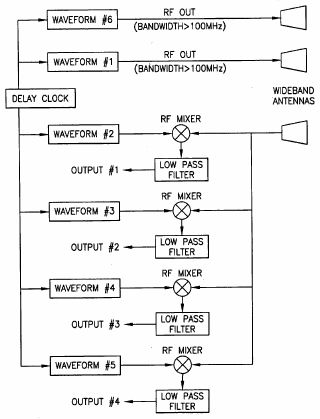
The system transmits a very low-intensity, ultra-wideband RF signal whose waveform is random or pseudorandom, making it appear as background noise to ordinary receivers. Reflected signals are processed to extract target information.
Principles
- Random/pseudorandom waveform generation
- Ultra-wideband low-intensity transmission
- Correlation-based detection of reflected noise
Scientific Domains
Mechanisms of Action
- Transmit low-power, wide-band RF noise
- Receive reflected RF energy
- Correlate received signal with transmitted waveform to identify targets
Energy Sources
Applications
- military surveillance
- law enforcement speed detection
- building interior monitoring
Claimed Performance
Undetectable to standard receivers; can penetrate solid walls; minimal interference with TV/radio communications.
Limitations
- Low signal intensity may limit detection range
- Requires specialized processing to extract the signal
- Potentially vulnerable to advanced signal-analysis techniques
Red Flags
- Lack of quantitative performance data
- No independent verification
- Claims based primarily on theoretical advantages