Goal
Provide an ultra-high-temperature-resistant, fire-retardant coating or material that can protect structures, equipment and personnel from extreme heat, fire, laser or nuclear-flash exposure.
Problem
Lack of lightweight, non-toxic, high-performance thermal barrier materials for aerospace, defence, fire safety and industrial applications.
Concept Summary
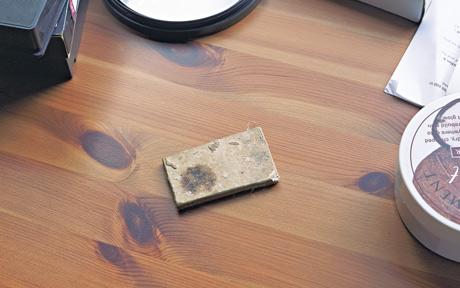
Starlite is a polymer-ceramic composite that, when applied as a coating or formed into a sheet, can withstand temperatures of 2 500 deg C (torch) up to 10 000 deg C (simulated nuclear flash) without burning, melting or emitting toxic fumes. The material reportedly forms a protective char layer and absorbs heat through endothermic reactions, giving it a very high heat-absorption rating (Q-value).
Detailed Description
Ward mixed up to 20 formulations per day using a food-mixer, combining up to 21 organic polymers and copolymers with small quantities of ceramic powders. The resulting material could be extruded into sheets or coated onto objects. Laboratory tests (UL94 VO, torch, laser, nuclear-flash simulations) showed the material remained intact, cooled the surface, and prevented combustion of underlying substrates (e.g., eggs). The exact composition remains secret and has not been patented.
Principles
- Thermal insulation
- Char formation and protective barrier
- Endothermic decomposition
- Low thermal conductivity of polymer-ceramic composites
Scientific Domains
Materials
- Organic polymers
- Copolymer blends
- Ceramic powders (e.g., alumina, silica)
- Plastic binder
Mechanisms of Action
- Formation of a refractory char layer that reflects and dissipates heat
- Endothermic chemical reactions that absorb thermal energy
- Low thermal conductivity of the polymer matrix
- Ceramic particles providing high melting point reinforcement
Applications
- Fire-resistant uniforms
- Fire doors
- Spacecraft heat shields
- Missile nose cones
- Aircraft and vehicle protection
- Nuclear-flash shielding for critical infrastructure
Claimed Performance
Resists 2 500 deg C torch exposure, 10 000 deg C simulated nuclear flash, 75 Hiroshima-equivalent blasts; passes UL94 VO test; Q-value of 2 470 vs 1 for Space Shuttle tiles; remains intact after laser pulsing.
Experimental Evidence
Tests at ICI (UL94 VO), torch tests on sheets, egg-coating tests on Tomorrow's World, nuclear-flash simulations at British Atomic Weapons Establishment (10 000 deg C), laser pulse tests at Royal Signals and Radar Establishment, White Sands nuclear test simulation; video documentation referenced.
Replication Status
No independent replication reported; all demonstrations performed by Ward or by government labs under non-disclosure.
Limitations
- Secret proprietary formulation; no publicly disclosed recipe
- No large-scale manufacturing process demonstrated
- Lack of peer-reviewed, independent validation
- Potential high cost of exotic polymers/ceramics
- Unclear long-term durability and environmental impact
Red Flags
- No peer-reviewed publications or third-party verification
- Secrecy and refusal to patent or disclose formulation
- Extraordinary performance claims that challenge conventional thermodynamics
- Reliance on anecdotal video evidence