Goal
Reduce boiler emissions, provide an environmentally friendly way to treat industrial wastewater, and increase fuel efficiency.
Problem
High pollutant emissions from heavy fuel oil boilers and costly treatment of industrial wastewater.
Concept Summary
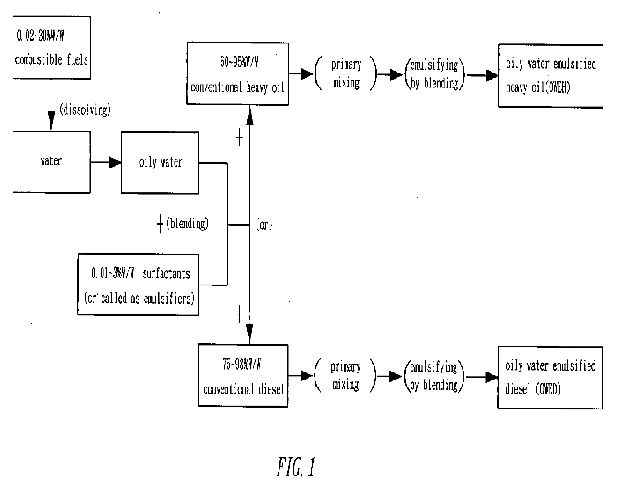
Industrial wastewater is mixed with heavy fuel oil and a small amount of surfactant to form an oil-in-water emulsion. The emulsion undergoes micro-explosions on ignition, producing fine fuel droplets that atomize more completely, lowering combustion temperature and reducing pollutants such as CO, NOx, SO2, PM and volatile organics while saving energy.
Principles
- Micro-explosion atomization
- Water-induced temperature reduction
- Surfactant-stabilized emulsion
Scientific Domains
Materials
- Heavy fuel oil (HFO)
- Industrial wastewater (high COD, oily)
- Surfactant (commercial emulsifier)
Mechanisms of Action
- Micro-explosions create fine fuel droplets
- Increased surface area improves combustion completeness
- Water dilutes fuel, lowering flame temperature and NOx formation
- Sulfur dilution reduces SO2 emissions
Energy Sources
Applications
- Industrial steam boilers
- Diesel engines (with modification)
Claimed Performance
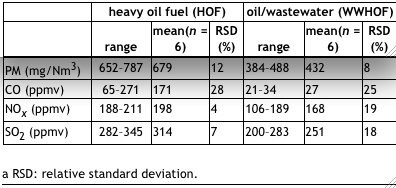
CO emissions reduced by 84 %; overall emissions (PM, NOx, SO2, VOCs) drastically reduced; energy savings ~= 13 %-14 % (fuel efficiency increase).
Experimental Evidence
Laboratory boiler tests showed 84 % reduction in CO, significant reductions in PM, NOx, SO2 and VOCs, and about 13 % energy saving when using 80 % HFO + 19.9 % wastewater + 0.1 % surfactant.
Limitations
- Requires precise surfactant dosage
- Potential reduction in flame temperature may affect some processes
- Scale-up and long-term engine wear not yet demonstrated