Goal
Increase the efficiency of central heating systems, reduce energy consumption and CO_2 emissions, and lower household heating bills.
Problem
Dissolved air in boiler water reduces heat transfer, causes noise, corrosion, and requires frequent bleeding of radiators.
Concept Summary
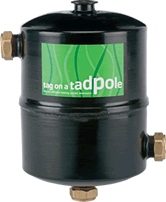
The Tadpole is a compact, retro-fit unit that attaches to the primary flow of a central heating system and continuously removes dissolved air from the heating water. By deaerating the water, the boiler reaches higher temperatures faster, operates more efficiently, and experiences less corrosion.
Detailed Description
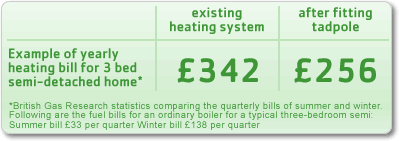
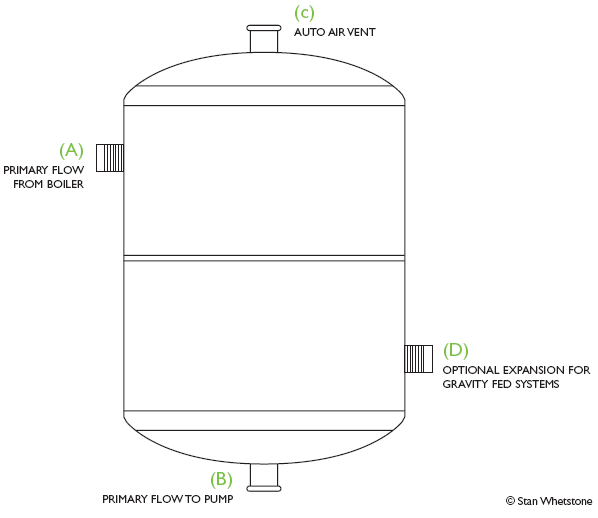
The device is installed upstream of the circulation pump and includes an automatic air vent. It works continuously without external power or moving parts, maintaining water with low dissolved-air content. The manufacturer claims a typical 30 % efficiency gain, a reduction of about 0.66 t CO_2 per year per household, and a drop in heating bills (e.g., from GBP600 to GBP420). Pilot installations in Northumberland and Nottingham reportedly gave "immediate and dramatic" savings. The unit measures 240 mm x 200 mm and fits 22 mm or 28 mm pipe connections. Installation takes roughly two hours by a competent plumber.
Principles
- Deaeration of heating water
- Improved heat transfer by removing dissolved gases
- Corrosion reduction through oxygen removal
Scientific Domains
Materials
- Stainless steel (housing)
- Plastic (fittings)
Mechanisms of Action
- Continuous removal of dissolved air from boiler water
- Lowering of oxygen content to reduce corrosion
- Faster heat-up of water due to higher thermal conductivity of deaerated water
Applications
- Residential central-heating efficiency improvement
- Domestic CO_2 emissions reduction
- Boiler corrosion mitigation
Claimed Performance
~=30 % increase in boiler efficiency; up to 0.66 t CO_2 reduction per house per year; heating-bill reduction from ~GBP600/yr to ~GBP420/yr; heat-up time for a 200 L cylinder reduced to 36 min.
Experimental Evidence
Inventor reports a 30 % efficiency gain after 12 months on his own gas boiler. Pilot tests with a firm in Northumberland and a heating engineer in Nottingham described "immediate and dramatic" savings.
Replication Status
Limited pilot testing (Northumberland firm, Nottingham heating engineer) and distribution to multiple regional installers.
Limitations
- Requires professional installation
- Performance may vary with boiler type and system age
- No independent third-party testing reported
Red Flags
- Heavy reliance on marketing language and anecdotal claims
- Absence of peer-reviewed or independently verified data
- No disclosed test methodology or statistical analysis