Goal
Increase engine torque and fuel economy while reducing exhaust back-pressure and noise.
Problem
Conventional mufflers create back-pressure and insufficient sound absorption, reducing engine efficiency and fuel economy.
Concept Summary
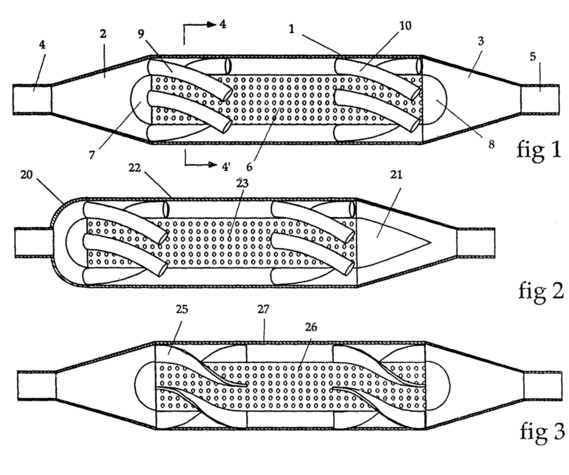
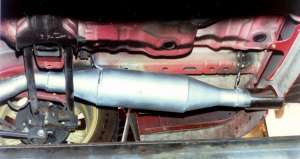
The muffler uses a solid tubular construction with conical ends and internal helical vanes that induce a strong vortex (swirl) in the exhaust flow. The vortex creates a suction effect that evacuates gases more efficiently, lowering back-pressure, improving low-end torque, and reducing fuel consumption. Perforated core walls and an absorbent glass-fiber material provide acoustic damping.
Detailed Description
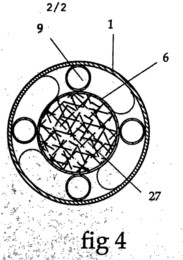
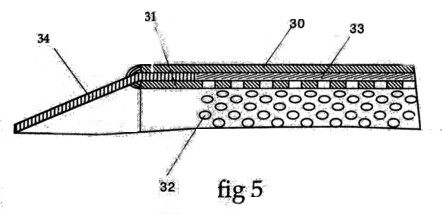
The invention comprises a cylindrical casing with tapered inlet and outlet ends, an elongated hollow core whose surface is perforated (up to 50 % open area, holes ~3 mm). Vanes extending between the core and casing are shaped helically to swirl the exhaust gases, producing a vortex that draws gases through the muffler with minimal back-pressure. Domed or conical ends aid flow, while glass-fiber or similar heat-resistant material inside the core absorbs sound. The design can be installed in place of a standard muffler, optionally with a resonator upstream.
Principles
- Vortex (swirl) flow
- Helical vane induced turbulence
- Acoustic absorption
- Heat dissipation
Scientific Domains
Materials
- Steel (casing)
- Aluminum (core)
- Glass fiber (absorber)
Mechanisms of Action
- Swirl-induced suction reduces back-pressure
- Helical vanes create helical flow
- Perforated core allows gas mixing
- Glass-fiber absorbent material dampens sound
Energy Sources
Applications
- Automotive exhaust systems
- Diesel trucks
- Tractors and earth-moving equipment
- Motorcycles
Claimed Performance
Fuel economy improvement up to 20 % (15-20 % typical); power increases of 5-7 bhp; torque and throttle response enhancements; back-pressure reduction.
Experimental Evidence
Multiple user testimonials and dyno test results showing 5-7 bhp power gains, 10-15 % fuel savings, and improved torque across various makes and models (e.g., Holden Commodore, Ford Fairmont, Toyota Landcruiser, Kawasaki ZX6).
Replication Status
Anecdotal replication reported by many vehicle owners and a few dyno tests; no formal independent peer-reviewed study.
Limitations
- Performance gains vary by vehicle and installation
- Evidence largely anecdotal
- No quantified long-term durability data
- May require resonator upstream for optimal sound
Red Flags
- Reliance on user testimonials rather than controlled studies
- Potential bias from inventor's marketing claims
- Lack of peer-reviewed validation