Goal
Concentrate solar radiation to produce high-intensity heat/steam for power generation and industrial heating.
Problem
Low efficiency of conventional solar collectors and the need for high-flux solar energy for electricity and district heating.
Concept Summary
A parabolic solar concentrator built from a lightweight aluminum frame and flexed glass mirrors that concentrates sunlight by a factor of ~1,000 suns onto a focal receiver, producing steam and temperatures sufficient to melt steel.
Detailed Description
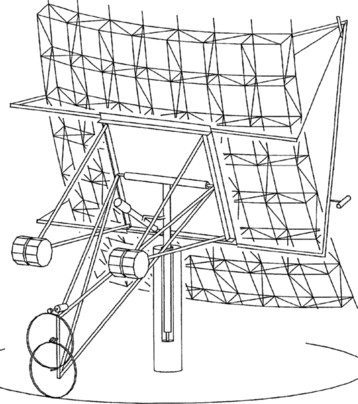
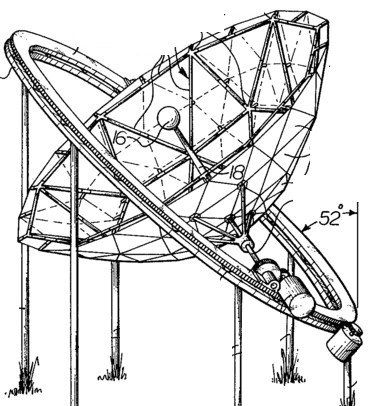
The Matrix Solar Dish uses orthogonal paraboloid trusses formed by flexing linear members with lateral forces and restraining them with rigid webbing. Thin flat glass mirrors are similarly flexed into parabolic shapes and held by tension buttons. The dish tracks the sun azimuthally with a bicycle-wheel mechanism and altitude with a television-satellite-dish actuator. A low-shade receiver sits at the focal point, receiving uniform flux >1000 suns, suitable for high-intensity photovoltaics or district heating.
Principles
- Solar concentration
- Parabolic geometry
- Flexed mirror fabrication
- Dual-axis solar tracking
Scientific Domains
Materials
- Aluminum tubing
- Flat glass mirrors
- Rigid webbing
- Tension buttons
- Steel receiver structure
Mechanisms of Action
- Reflect and focus sunlight onto a focal receiver
- Convert concentrated solar energy to heat/steam
Energy Sources
Applications
- Electric power generation
- District heating
- Industrial process heat
Claimed Performance
Concentrates sunlight by a factor of 1,000 suns; capable of melting steel and generating steam; described as the most efficient solar collector in existence.
Experimental Evidence
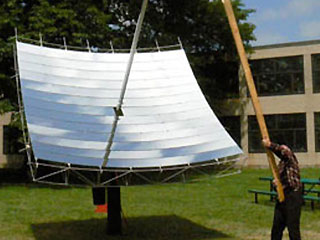
MIT mechanical engineering test where a plank of wood placed at the focal point ignited instantly, producing a puff of smoke.
Limitations
- Requires direct sunlight; performance drops with cloud cover
- Large structural footprint
- Mechanical tracking complexity
- Potential mirror degradation over time