Goal
Reduce weed density and biomass while increasing crop yields in organic vegetable production.
Problem
Lack of effective, non-chemical weed control options for organic farms, leading to excessive tillage and reliance on fossil-fuel-intensive methods.
Concept Summary
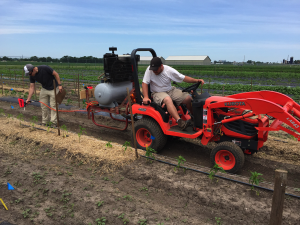
Air-propelled abrasive grits (organic fertilizers, walnut shells, corn cobs, etc.) are blasted onto crop rows using a compressed-air nozzle. The high-velocity particles physically damage and kill small weed seedlings, while the organic material simultaneously supplies nutrients to the crop.
Detailed Description
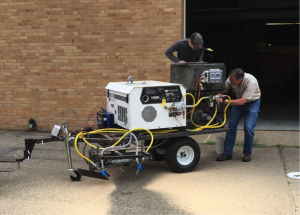
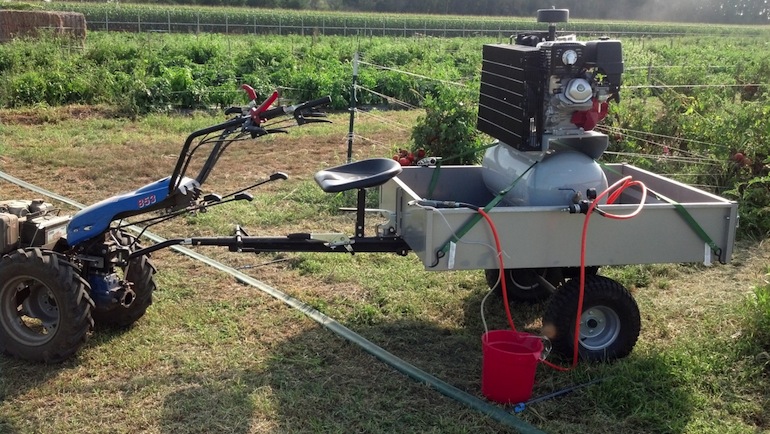
The system consists of a hand-held or tractor-mounted applicator that feeds granular abrasive material into a 100 psi air stream. The mixture is directed in a 4-6 inch band within the plastic mulch row. When the particles strike weed seedlings (typically <= two leaves), the kinetic energy causes stem and leaf abrasion, killing the plant. The same particles, being organic fertilizers, release nitrogen and other nutrients over time, contributing 35-105 kg N ha^-^1. Field trials at the University of Illinois over two growing seasons showed 63-80 % reduction in weed density, 69-97 % reduction in weed biomass, and up to 44 % higher tomato yields compared with untreated controls. No significant crop injury was observed beyond minor stem curvature.
Principles
- Kinetic energy impact of high-velocity particles
- Air propulsion of abrasive media
- Physical abrasion of plant tissue
- Nutrient supplementation from organic grit
Scientific Domains
Materials
- Granulated walnut shells
- Corn cob granules
- Greensand fertilizer
- Soybean meal
- Bone meal fertilizer
- Corn gluten meal
Mechanisms of Action
- Abrasion of weed seedlings leading to tissue rupture
- Defoliation of small plants
- Supplemental nitrogen release from organic grit
Energy Sources
Applications
- Organic vegetable weed management
- Dual-purpose fertilization and weed suppression
- Reduced tillage farming
Claimed Performance
Weed density reduced by 63-80 %; weed biomass reduced by 69-97 %; tomato yield increased up to 44 %; nitrogen contribution of 35-105 kg N ha^-^1.
Experimental Evidence
Two-year field study at University of Illinois Sustainable Student Farm; greenhouse trials with six organic grit types; quantitative measurements of weed density, biomass, and crop yield; statistical significance reported (p < 0.05 for most comparisons).
Replication Status
Field study conducted and reported; prototype applicator tested; no independent third-party replication reported.
Limitations
- Potential minor damage to crop stems and leaves
- Effectiveness limited to very young seedlings (<= two leaves)
- Requires portable air compressor and protective eyewear
- Economic feasibility depends on grit cost and application rate