Goal
Provide a clear, high-pH magnesium hydroxide solution that does not form sludge, is safer to handle than NaOH/KOH, and can be used for metal cleaning, acid neutralization, and potentially antibacterial applications.
Problem
Sludge formation and sodium ion contamination in conventional high-pH industrial cleaning and neutralization processes; need for a safer, non-reactive alkaline solution.
Concept Summary
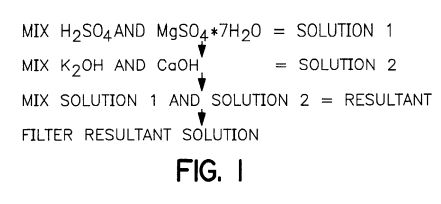
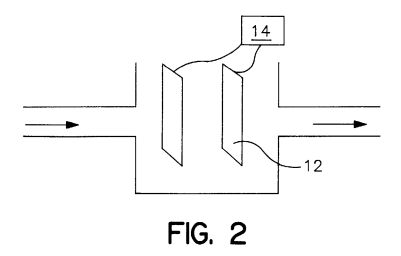
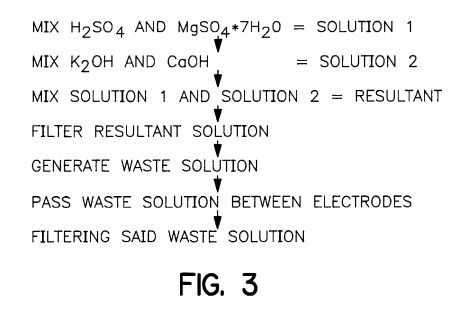
A method mixes a magnesium sulfate-sulfuric acid solution with a calcium hydroxide-potassium hydroxide solution, causing CaSO_4 precipitation and coprecipitation of potassium. After filtration, the filtrate is a clear solution containing Mg^2^+ and OH^- at pH 10-13.9, free of sludge and low in sulfate and potassium. Magnesium can later be removed electrochemically by applying 79-83 V across iron electrodes, precipitating Mg(OH)_3.
Principles
- Precipitation and coprecipitation to remove unwanted ions
- pH control via strong base addition
- Electrochemical precipitation of magnesium hydroxide
Scientific Domains
Materials
- magnesium sulfate (MgSO_4*7H_2O)
- sulfuric acid (H_2SO_4)
- calcium hydroxide (Ca(OH)_2)
- potassium hydroxide (KOH)
- deionized water
- iron (electrode material)
Mechanisms of Action
- Sludge prevention by precipitating CaSO_4 and K^+
- High-pH cleaning through Mg(OH)_2 solution
- Electrochemical removal of Mg^2^+ as Mg(OH)_3
Energy Sources
Applications
- metal cleaning
- acid waste neutralization
- industrial cleaning processes
- potential antibacterial treatment for MRSA
Claimed Performance
Solution pH 13.7, sulfate < 500 ppm, potassium below detection, clear, sludge-free, safe for human tissue.
Experimental Evidence
The filtrate measured pH 13.7; spectrometer showed 54 ppm Ca^2^+, < 500 ppm SO_4^2^-, potassium below detection. Comparative procedures showed conventional MgO/H_2O solutions gave pH ~= 9.45 or < 1 % dissolution, demonstrating superiority of the invented method.
Limitations
- Requires filtration equipment
- Handling of strong acids and bases
- Efficacy against MRSA not clinically validated
Red Flags
- Claims of MRSA inhibition lack clinical data
- Potential misuse as an unproven disinfectant