Goal
Restore macrophage activity to treat cancer, HIV infection, and osteopetrosis by supplying the active macrophage-activating factor.
Problem
Immunosuppression in cancer and HIV patients caused by loss or reduction of the Gc-protein precursor activity for macrophage activation.
Concept Summary
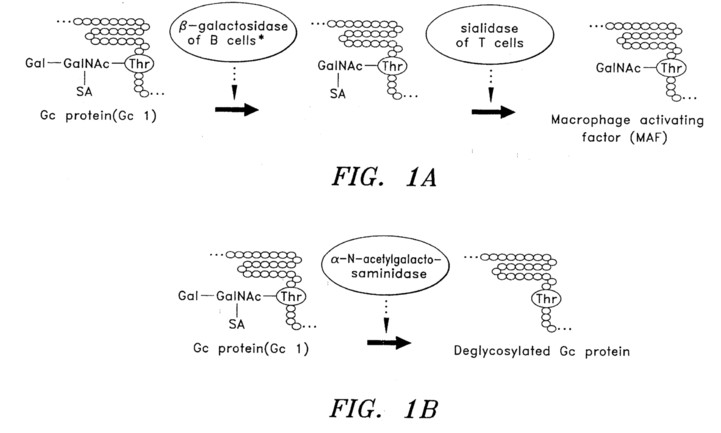
Serum vitamin-D-binding protein (Gc protein) is a precursor that, after stepwise enzymatic treatment with beta-galactosidase and sialidase, becomes GcMAF, a potent macrophage-activating factor. Administration of minute doses of GcMAF restores phagocytic and superoxide-producing capacity of macrophages, counteracting immunosuppression observed in many cancer and HIV patients. The invention also provides assays to detect loss of precursor activity and the presence of deglycosylating alpha-N-acetylgalactosaminidase in patient serum.
Principles
- Enzymatic deglycosylation
- Macrophage activation
- Immune modulation
- Diagnostic assay for enzyme activity
Scientific Domains
Materials
- Vitamin-D-binding protein (Gc protein)
- beta-galactosidase (immobilized)
- Sialidase (immobilized)
- Lysophosphatidylcholine (Lyso-Pc)
- Ammonium sulfate
- Citrate-phosphate buffer
Mechanisms of Action
- beta-galactosidase removes terminal galactose residues from Gc protein
- Sialidase removes sialic acid, leaving N-acetylgalactosamine as the terminal sugar
- Resulting GcMAF binds to macrophage receptors, enhancing phagocytosis and superoxide generation
Applications
- Therapeutic treatment of cancer
- Therapeutic treatment of HIV/AIDS
- Treatment of osteopetrosis
- Adjuvant for vaccines
Claimed Performance
Administration of as little as 10 pg per mouse (~=100 ng per human) of GcMAF produced a markedly enhanced phagocytic capacity of macrophages; in vitro treatment of monocytes from 175 cancer patients with 100 pg GcMAF / ml activated phagocytosis and superoxide generation in all samples.
Experimental Evidence
Mouse studies showing enhanced macrophage activity after lyso-Pc treatment; in-vitro assays on monocytes from 175 cancer patients and 65 HIV-infected patients demonstrating activation with GcMAF; enzyme activity measurements in tumor tissue homogenates.
Limitations
- Requires purified enzymes and controlled enzymatic steps
- Variable precursor activity among patients
- Lack of large-scale, peer-reviewed clinical trials
- Potential regulatory hurdles for biologic therapy
Red Flags
- Claims of "cure" without robust randomized clinical data
- Commercial products marketed without FDA approval
- Potential for misuse as an unproven "miracle" therapy