Goal
Provide passive, zero-energy cooling for structures and thermoelectric power-plant condensers.
Problem
High water and electricity consumption of conventional wet-cooling systems for buildings and power plants.
Concept Summary
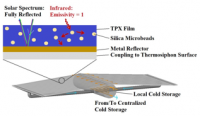
A 50-um-thick glass-polymer hybrid metamaterial film coated with a thin silver layer reflects most solar radiation while emitting strong infrared radiation through the atmospheric window, enabling daytime radiative cooling without electricity or water.
Detailed Description
The metamaterial consists of visibly-scattering glass microspheres embedded in a polymer matrix; a silver backing enhances solar reflectivity. The roll-to-roll manufactured film can be applied to roofs, solar panels, or as the top layer of a thermosiphon cold-storage module. Under direct sunlight it achieves a radiative cooling power of about 93 W/m^2 (and >100 W/m^2 in the Radicold system) and can reduce building temperatures and improve solar-panel efficiency by 1-2 %. A 200-m^2 prototype is planned for 2017.
Principles
- Passive radiative cooling
- Solar reflectivity
- Infrared emissivity
Scientific Domains
Materials
- Glass microspheres
- Polymer matrix
- Silver coating
Mechanisms of Action
- Reflect incoming solar radiation
- Emit infrared radiation through atmospheric window
- Create temperature gradient that drives thermosiphon water flow
Applications
- Building roof and ceiling cooling
- Thermoelectric power-plant condenser cooling
- Solar panel temperature management
Claimed Performance
Noon-time radiative cooling power of 93 W/m^2 under direct sunshine; heat flux >100 W/m^2 day-and-night; 10-20 m^2 can cool a single-family house; 1-2 % solar-panel efficiency recovery.
Experimental Evidence
Demonstrated 93 W/m^2 cooling power in laboratory tests; roll-to-roll manufacturing demonstrated; prototype of 200 m^2 planned.
Replication Status
Patented; prototype planned; no independent third-party replication reported.
Limitations
- Performance depends on clear sky and atmospheric transparency
- Scaling roll-to-roll production to large commercial volumes
- Cooling power limited to ~100 W/m^2, may be insufficient for high-load applications