Goal
Convert thermal or solar energy fluctuations directly into high-efficiency electrical power.
Problem
Low-grade heat and solar energy are difficult to convert efficiently into electricity with conventional thermoelectric or photovoltaic devices.
Concept Summary
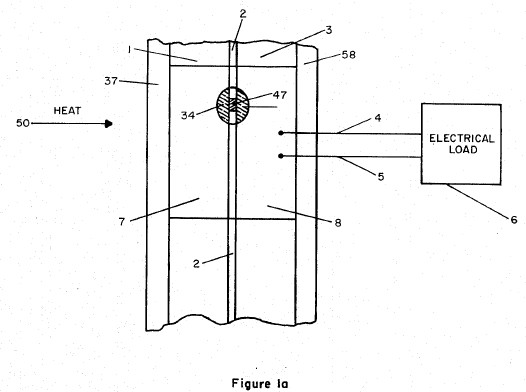
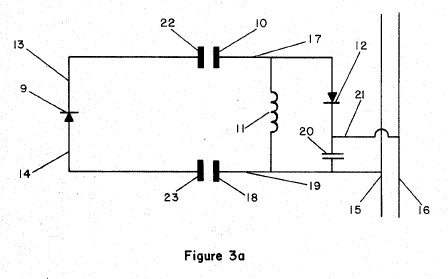
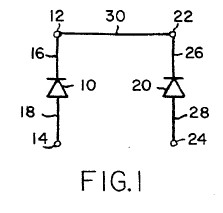
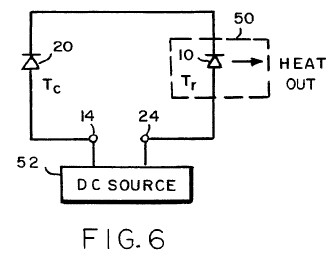
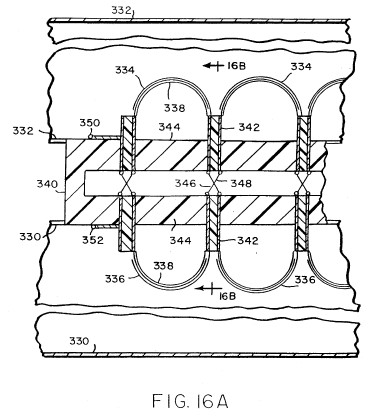
The invention uses quantum-well diode structures to harness voltage fluctuations that arise from temperature differences across a thermal barrier. By coupling these fluctuations between a hot diode and a cold diode, the system rectifies the noise into a usable DC output, theoretically approaching 91-99 % of the Carnot-cycle efficiency.
Principles
- Thermoelectric effect
- Quantum-well diode voltage fluctuations
- Fluctuation-driven rectification
- Reversible heat-to-electric conversion
- Carnot-cycle efficiency limit
Scientific Domains
Materials
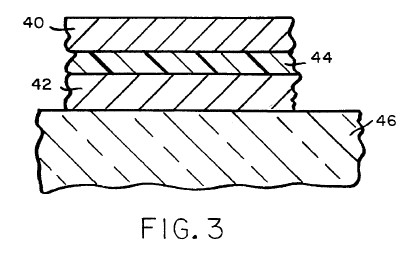
- Semiconductor quantum-well structures (e.g., GaAs/AlGaAs)
- Dielectric barrier layer
- Thin-film diode materials
- Thermionic emission materials
Mechanisms of Action
- Thermal fluctuations generate voltage noise in a hot quantum-well diode
- Voltage fluctuations are coupled across a thermal barrier to a cold diode
- Rectifying circuits convert the coupled fluctuations into DC power
- Heat is transferred from low-temperature to high-temperature side, enabling reversible operation
Energy Sources
Applications
- Earth-based solar power generation
- Waste-heat recovery in steam power plants
- Space solar power stations
- Heat pumps and refrigeration
- Low-noise amplification for radio receivers
Claimed Performance
Maximum output power within 91-99 % of Carnot-cycle efficiency for the reversible cycle; high-efficiency conversion of thermal fluctuations to DC power.
Experimental Evidence
The article cites theoretical calculations and selected experimental values for diode nonlinearity factors; no independent quantitative performance data are presented.
Limitations
- Requires precise quantum-well diode fabrication
- Thermal barrier design is critical and not fully demonstrated
- No independent replication of claimed efficiencies
- Scalability of planar arrays not proven
Red Flags
- Claims of >90 % Carnot efficiency without peer-reviewed experimental data
- Potential overunity implications that conflict with the second law of thermodynamics
- Lack of independent replication or commercial deployment