Goal
Produce clean, safe drinking water from any source using ambient sunlight.
Problem
Lack of affordable, energy-efficient desalination and water purification methods; high mortality from unsafe water.
Concept Summary
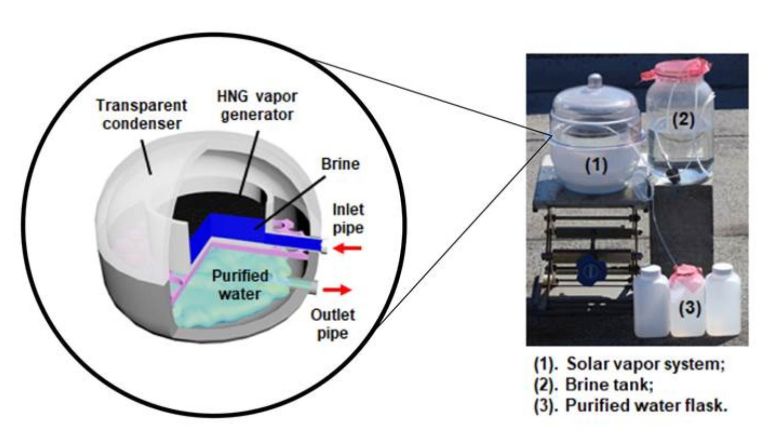
A solar-driven vapor generator that uses a nanostructured hydrogel composed of polyvinyl alcohol and polypyrrole. The hydrogel's hydrophilic network draws water into its molecular mesh while its semiconducting polymer absorbs sunlight, heating the water and reducing its latent heat of evaporation. The generated vapor is condensed to yield fresh water.
Principles
- Solar photon absorption
- Photothermal heating
- Evaporation with reduced latent heat
- Nanostructured hydrogel network
- Hydrophilic water transport
Scientific Domains
Materials
- Polyvinyl alcohol (PVA)
- Polypyrrole (PPy)
- Water
- Silicate ester (for coating variant)
- Silica (for coating variant)
- Aniline (for coating variant)
- Pyrrole derivatives (for coating variant)
Mechanisms of Action
- Semiconducting polymer (polypyrrole) converts sunlight to heat
- Hydrogel mesh holds water close to heat source, lowering evaporation energy
- Ambient solar radiation provides energy
- Vapor is condensed in a separate condenser to collect fresh water
Energy Sources
Applications
- Household drinking-water supply
- Disaster-relief water provisioning
- Large-scale desalination plants
Claimed Performance
Up to 25 L m^-^2 day^-^1 of distilled water; evaporation rate 3.2 kg m^-^2 h^-^1 with 94 % solar-energy utilization; reduced salinity of Dead Sea water to WHO drinking-water standards.
Experimental Evidence
Outdoor tests produced 25 L m^-^2 day^-^1; laboratory measurements showed 3.2 kg m^-^2 h^-^1 evaporation under 1 sun; Dead Sea brine passed drinking-water standards after treatment.
Replication Status
Demonstrated in laboratory and outdoor field tests by the UT Austin research team; no independent third-party replication reported.
Limitations
- Performance depends on solar irradiance; reduced output on cloudy days
- Long-term durability of hydrogel under continuous cycling not yet proven
- Scale-up of nanostructured gel manufacturing may present cost challenges