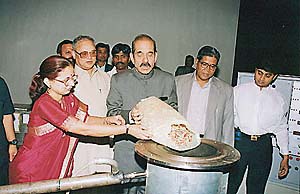
Goal
Convert non-biodegradable plastic waste into liquid hydrocarbon fuels (diesel, petrol) and useful gases.
Problem
Plastic waste pollution and shortage of affordable fossil fuels.
Concept Summary
A continuous industrial process that thermally cracks shredded plastic mixed with a small amount of coal in the presence of a proprietary zeolite-based catalyst, producing a high-yield liquid fuel fraction (~85 %) and a gaseous fraction (~15 %). The process is operated in a sealed stainless-steel reactor with temperature control, condensation, and gas-handling units.
Detailed Description
The plant uses a cylindrical stainless-steel vessel equipped with a pressure gauge, timer and temperature sensors. Plastic waste (~=90 % of feed) is shredded, mixed with coal (~=10 % of feed) and a secret chemical catalyst derived from a faujasite zeolite, pseudoboehmite alumina, polyammonium silicate and kaolin clay. The mixture is heated anaerobically (electrically or by coal combustion) to temperatures sufficient for catalytic cracking. Vapours pass into a condenser where liquid hydrocarbons are collected; non-condensable gases are routed to a gas-meter or used for electricity generation. Solid coke remains as residue. The plant currently processes 10 t d^-^1 of plastic, with plans to scale to 25 t d^-^1, yielding 10 000-25 000 L d^-^1 of fuel.
Principles
- Catalytic cracking
- Thermal pyrolysis
- Anaerobic heating
- Zeolite catalysis
Scientific Domains
Materials
- Faujasite zeolite
- Pseudoboehmite alumina
- Polyammonium silicate
- Kaolin clay
- Stainless steel
- Coal
- Various plastic polymers (PET, PVC, ABS, etc.)
- Water (for catalyst slurry)
Mechanisms of Action
- Thermal decomposition of polymer chains
- Catalyst-mediated bond scission
- Hydrocarbon reforming
- Coal co-feeding for hydrogen supply
Energy Sources
Applications
- Industrial diesel and petrol supply
- Agricultural pump fuel
- Marine fuel
- LPG substitute for boilers
Claimed Performance
100 % conversion of plastic waste; 85 % of feed mass becomes liquid fuel, 15 % becomes gases; 1 kg plastic + 0.1 kg coal yields ~1 L fuel.
Experimental Evidence
Pilot plant in Butibori processes 10 t d^-^1 of plastic, producing 10 000 L d^-^1 of fuel; demonstrations performed in Delhi, Mumbai and Pune; Indian Oil Corporation R&D certified the process; patent filed (WO2005094990).
Replication Status
Process demonstrated in a continuous industrial pilot plant; certified by Indian Oil Corporation; multiple independent demonstrations reported.
Limitations
- Current plant capacity limited to ~25 t d^-^1
- Requires coal co-feeding, adding logistics
- Catalyst preparation involves multiple steps and calcination
Red Flags
- Claims of zero pollution without detailed emission data
- Potential undisclosed by of coke and gases