Goal
Non-surgical dissolution or reversal of cataract opacity to restore lens transparency and vision.
Problem
Cataracts - protein aggregation in the eye lens that causes clouding and blindness, currently treated only by surgical lens replacement.
Concept Summary
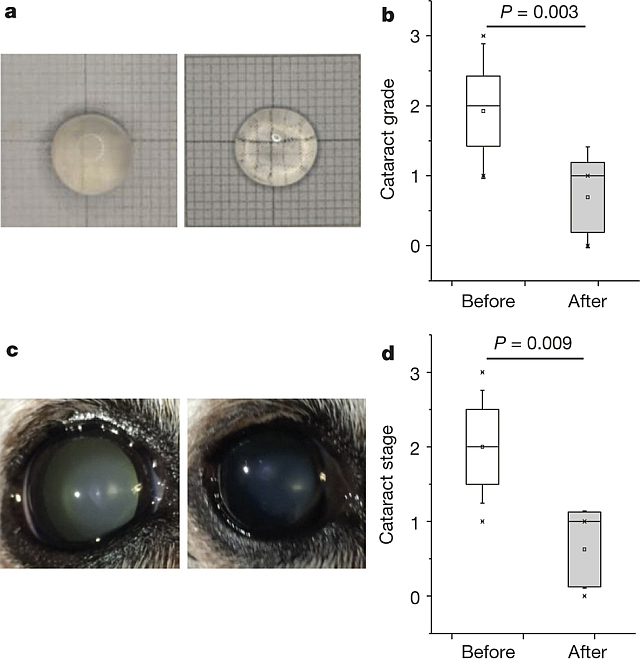
A naturally occurring steroid, lanosterol, is formulated as an ophthalmic eye-drop. Pre-clinical studies in rabbit lenses and cataract-prone dogs showed that repeated administration reduces protein aggregation, clears lens opacity and improves visual function. The approach aims to replace or supplement cataract surgery with a pharmacological therapy.
Detailed Description
Zhang and colleagues identified mutations in the lanosterol synthase (LSS) gene that prevent endogenous lanosterol production and lead to congenital cataracts. They prepared a lanosterol solution and applied it to isolated rabbit lenses in vitro for six days, achieving clarity in 11 of 13 samples. In vivo, dogs received twice-daily eye-drops for six weeks; three of seven dogs showed complete vision restoration and the remaining four exhibited partial improvement. The researchers plan human trials to determine safety and efficacy. A related patent describes a method for extracting lanosterol from lanolin alcohol, indicating a potential production route.
Principles
- Steroid-mediated disruption of lens protein aggregates
- Restoration of lens transparency via solubilization of crystallin clumps
Scientific Domains
Materials
- Lanosterol (steroid)
- Methanol
- Acetone
- Lanolin alcohol (as a source of lanosterol in the patent)
Mechanisms of Action
- Lanosterol interferes with hydrophobic interactions that cause crystallin aggregation
- Promotes refolding or clearance of misfolded lens proteins
Applications
- Therapeutic treatment of existing cataracts
- Prevention of cataract formation in at-risk populations
Claimed Performance
Effective in 11 of 13 rabbit lenses (in vitro) and cleared vision in 3 of 7 dogs, with partial improvement in the remaining four after six weeks of twice-daily dosing.
Experimental Evidence
Animal studies demonstrated that lanosterol solution cleared protein aggregates in dissected rabbit lenses and improved lens transparency in dogs with naturally occurring cataracts. No human data were presented.
Replication Status
No independent replication reported; results are limited to the authors' pre-clinical studies.
Limitations
- Results limited to short-term animal studies
- Potential for cataract redevelopment after treatment cessation
- No human clinical data yet
Red Flags
- Lack of independent replication
- Claims of "reversal" based on limited animal data
- Potential over-optimism without human trial evidence