Michael Bernitsas -- VIVACE : Vortex-Induced Vibrations for
Clean Aquatic Energy
****
**[rexresearch.com](../index.htm)**
---
**Michael BERNITSAS, *et al.***
**VIVACE**
**( Vortex-Induced Vibrations for Aquatic
Clean Energy )**
---
****
**Vortex Hydro Energy**
**2512 Carpenter Road Suite #101-C**
**Ann Arbor**
**MI 48108**
**Phone: (734) 223-4223**
**Fax: (734) 944-4072**
---
**VIVACE (Vortex Induced Vibrations for
Aquatic Clean Energy)**
A novel approach to extract energy from flowing water currents.
It is unlike any other ocean energy or low-head hydropower
concept. VIVACE is based on the extensively studied phenomenon
of Vortex Induced Vibrations (VIV), which was first observed 500
years ago by Leonardo DaVinci in the form of Aeolian Tones.
For decades, engineers have been trying to prevent VIV from
damaging offshore equipment and structures. By maximizing and
exploiting VIV rather than spoiling and preventing it, VIVACE
takes this problem and transforms it into a valuable resource
for mankind.
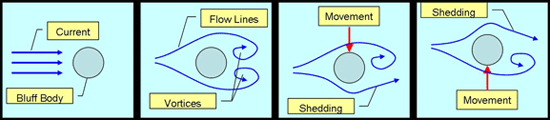
Vortex Induced Vibrations (VIV) result from vortices forming
and shedding on the downstream side of a bluff body in a
current. Vortex shedding alternates from one side to the other,
thereby creating a vibration or oscillation. The VIV phenomenon
is non-linear, which means it can produce useful energy at high
efficiency over a wide range of current speeds.
VIVACE devices have many potential advantages, which improve
installation survivability in the hostile underwater environment
and enable low-cost power production by decreasing capital cost
and minimizing maintenance.
*High energy density* - permits low cost energy to be
produced from relatively small installations - requiring up to
50 times less ocean acreage than wave power concepts.
*Simple and rugged moving parts* - allows for robust
designs that can operate for long periods in the underwater
environment with minimal maintenance.
*Low dependence on ocean/river conditions* - application
of non-linear resonance permits useful energy to be extracted
over a wide range of current speeds.
VIVACE and other renewable energy technologies also face
regulatory hurdles. Again, VIVACE is advantaged by salient
benefits over other technologies.
*Non-obtrusiveness* - installations can be positioned
beneath the surface, thereby avoiding interference with other
uses, such as fishing, shipping and tourism.
*Compatibility with marine life* - VIVACE utilizes vortex
formation and shedding, which is the same mechanism fish use to
propel themselves through the water.
Prototype, funded by the U.S. Department of Energy and the
Office Naval Research, is currently operating in the Marine
Hydrodynamics Laboratory at the University of Michigan. This
device has met and often exceeded expectations; thereby,
providing strong evidence to proceed to the next scale, a
multi-kilowatt field demonstration.
**Video :-- **
---
[**http://www.ns.umich.edu/htdocs/releases/story.php?id=6842**](http://www.ns.umich.edu/htdocs/releases/story.php?id=6842)
**'Fish Technology' Draws Renewable Energy
from Slow Water Currents**
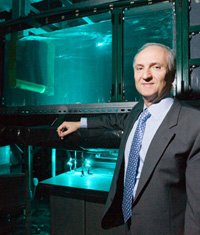
**Michael Bernitsas, professor in the Department of Naval
Architecture and Marine Engineering, stands before a prototype
of his VIVACE hydrokinetic energy device.**
**Credit: Scott Galvin**
*Slow-moving ocean and river currents could be a new,
reliable and affordable alternative energy source. A University
of Michigan engineer has made a machine that works like a fish
to turn potentially destructive vibrations in fluid flows into
clean, renewable power.*
The machine is called VIVACE. A paper on it is published in the
current issue of the quarterly Journal of Offshore Mechanics and
Arctic Engineering.
VIVACE is the first known device that could harness energy from
most of the water currents around the globe because it works in
flows moving slower than 2 knots (about 2 miles per hour.) Most
of the Earth's currents are slower than 3 knots. Turbines and
water mills need an average of 5 or 6 knots to operate
efficiently.
VIVACE stands for Vortex Induced Vibrations for Aquatic Clean
Energy. It doesn't depend on waves, tides, turbines or dams.
It's a unique hydrokinetic energy system that relies on "vortex
induced vibrations."
Vortex induced vibrations are undulations that a rounded or
cylinder-shaped object makes in a flow of fluid, which can be
air or water. The presence of the object puts kinks in the
current's speed as it skims by. This causes eddies, or vortices,
to form in a pattern on opposite sides of the object. The
vortices push and pull the object up and down or left and right,
perpendicular to the current.
These vibrations in wind toppled the Tacoma Narrows bridge in
Washington in 1940 and the Ferrybridge power station cooling
towers in England in 1965. In water, the vibrations regularly
damage docks, oil rigs and coastal buildings.
"For the past 25 years, engineersmyself includedhave been
trying to suppress vortex induced vibrations. But now at
Michigan we're doing the opposite. We enhance the vibrations and
harness this powerful and destructive force in nature," said
VIVACE developer Michael Bernitsas, a professor in the U-M
Department of Naval Architecture and Marine Engineering.
Fish have long known how to put the vortices that cause these
vibrations to good use.
"VIVACE copies aspects of fish technology," Bernitsas said.
"Fish curve their bodies to glide between the vortices shed by
the bodies of the fish in front of them. Their muscle power
alone could not propel them through the water at the speed they
go, so they ride in each other's wake."
This generation of Bernitsas' machine looks nothing like a
fish, though he says future versions will have the equivalent of
a tail and surface roughness a kin to scales. The working
prototype in his lab is just one sleek cylinder attached to
springs. The cylinder hangs horizontally across the flow of
water in a tractor-trailer-sized tank in his marine renewable
energy laboratory. The water in the tank flows at 1.5 knots.
Here's how VIVACE works: The very presence of the cylinder in
the current causes alternating vortices to form above and below
the cylinder. The vortices push and pull the passive cylinder up
and down on its springs, creating mechanical energy. Then, the
machine converts the mechanical energy into electricity.
Just a few cylinders might be enough to power an anchored ship,
or a lighthouse, Bernitsas says. These cylinders could be
stacked in a short ladder. The professor estimates that array of
VIVACE converters the size of a running track and about two
stories high could power about 100,000 houses. Such an array
could rest on a river bed or it could dangle, suspended in the
water. But it would all be under the surface.
Because the oscillations of VIVACE would be slow, it is
theorized that the system would not harm marine life like dams
and water turbines can.
Bernitsas says VIVACE energy would cost about 5.5 cents per
kilowatt hour. Wind energy costs 6.9 cents a kilowatt hour.
Nuclear costs 4.6, and solar power costs between 16 and 48 cents
per kilowatt hour depending on the location.
"There won't be one solution for the world's energy needs,"
Bernitsas said. "But if we could harness 0.1 percent of the
energy in the ocean, we could support the energy needs of 15
billion people."
The researchers recently completed a feasibility study that
found the device could draw power from the Detroit River. They
are working to deploy one for a pilot project there within the
18 months.
This work has been supported by the U.S. Department of Energy,
the Office of Naval Research, the National Science Foundation,
the Detroit/Wayne County Port Autrhority, the DTE Energy
Foundation, Michigan Universities Commercialization Initiative,
and the Link Foundation. The technology is being commercialized
through Bernitsas' company, Vortex Hydro Energy.
The paper is called "VIVACE (Vortex Induced Vibration for
Aquatic Clean Energy): A New Concept in Generation of Clean and
Renewable Energy from Fluid Flow."
---
[**http://www.vortexhydroenergy.com/html/news.html**](http://www.vortexhydroenergy.com/html/news.html)
**Technical Papers and Presentations**
***VIVACE (Vortex Induced Vibration Aquatic Clean Energy): A
NEW CONCEPT IN GENERATION OF CLEAN AND RENEWABLE ENERGY FROM
FLUID FLOW***
M.M. Bernitsas, K. Raghavan, Y. Ben-Simon, E. M. H. Garcia,
VIVACE (Vortex Induced Vibration Aquatic Clean Energy): A New
Concept in Generation of Clean and Renewable Energy from Fluid
Flow, Journal of Offshore Mechanics and Arctic Engineering,
ASME Transactions, in press; also invited paper, Proceedings of
the 25th International Conference on Offshore Mechanics and
Arctic Engineering (OMAE 06), Paper #92645, Hamburg, Germany,
June 4-9, 2006.
***THE VIVACE CONVERTER: MODEL TESTS AT HIGH DAMPING AND
REYNOLDS NUMBER AROUND 10^5***
M.M. Bernitsas, Y. Ben-Simon, K. Raghavan, E. M. H. Garcia, The
VIVACE Converter: Model Tests at Reynolds Numbers Around 10^5",
Journal of Offshore Mechanics and Arctic Engineering, ASME
Transactions, in press; also invited paper, Proceedings of the
25th International Conference on Offshore Mechanics and Arctic
Engineering (OMAE 06), Paper #92652, Hamburg, Germany, June
4-9, 2006.
***VIVACE: A New Concept for Harnessing Hydrokinetic Energy***
CITRIS and Ocean Engineering Seminar - University of California,
Berkeley
***Reynolds Number Effect on Vortex Induced Vibrations***
Raghavan, K., Bernitsas, M. M., and Maroulis, D., (2007),
"Effect of Reynolds Number on Vortex Induced Vibrations," IUTAM
Symposium, Hamburg, Germany. (Invited Paper)
***VIVACE Technology Progress & Path Forward***
U.S. Department of Energy Presentation
***EFFECT OF BOTTOM BOUNDARY ON VIV FOR ENERGY HARNESSING AT
8x10^3 < Re < 1.5x10^5***
Raghavan, K., Bernitsas, M. M., and Maroulis, D., (2007b),
"Effect of Bottom Boundary on VIV for Energy Harnessing at
8x10^3 < Re < 1.5x10^5", Journal of Offshore Mechanics and
Arctic Engineering, ASME Transactions, submitted; also invited
paper, Proceedings of the 26th International Conference on
Offshore Mechanics and Arctic Engineering (OMAE 07), Paper
#29727, San Diego, California, June 10-15, 2007.
***EFFECT OF FEE SURFACE ON VIV FOR ENERGY HARNESSING AT
8x10^3 < Re < 1.5x10^5***
Bernitsas, M. M., Raghavan, K., and Maroulis, D., (2007a),
"Effect of Free Surface on VIV for Energy Harnessing at 8x10^3
< Re < 1.5x10^5", Journal of Offshore Mechanics and Arctic
Engineering, ASME Transactions, submitted; also invited paper,
Proceedings of the 26th International Conference on Offshore
Mechanics and Arctic Engineering (OMAE 07), Paper #29726, San
Diego, California, June 10-15, 2007.
***INDUCED SEPARATION AND VORTICITY USING ROUGHNESS IN VIV
OF CIRUCLAR CYLINDERS AT 8x10^3 < Re < 1.5x10^5***
Bernitsas, M. M., Raghavan, K., and Duchene, G., (2007),
"Induced Separation and Vorticity Using Roughness in VIV of
Circular Cylinders at 8x10^3 < Re < 1.5x10^5," OMAE2008 -
June 15-20, 2008, Estoril, Portugal.
***ENHANCEMENT OF HIGH DAMPING VIV THROUGH ROUGHNESS
DISTRIBUTION FOR ENERGY HARNESSING AT 8x10^3 < Re <
1.5x10^5***
Raghavan, K., and Bernitsas, M. M., (2007), "Enhancement of High
Damping Viv through Roughness Distribution for Energy Harnessing
at 8x10^3 < Re < 1.5x10^5," OMAE2008 - June 15-20, 2008,
Estoril, Portugal.
***REDUCTION / SUPPRESSION OF VIV OF CIRUCLAR CYLINDERS
THROUGH ROUGHNESS DISTRIBUTION AT 8x10^3 < Re <
1.5x10^5***
Bernitsas, M. M., and Raghavan, K., (2007),
"Reduction/Suppression of VIV of Circular Cylinders through
Roughness Distribution at 8x10^3 < Re < 1.5x10^5,"
OMAE2008 - June 15-20, 2008, Estoril, Portugal.
---
[**http://blog.wired.com/wiredscience/2008/10/hidden-vortex-i.html**](http://blog.wired.com/wiredscience/2008/10/hidden-vortex-i.html)
**Tapping the Vortex for Green Energy**
**by** **Alexis Madrigal**
A bane of Big Oil's offshore rigs could become a boon for
renewable energy.
By tapping the natural motion of slow-moving water, a new
hydrokinetic generator could open vast new swaths of the ocean
for energy production.
When ocean currents flow over any kind of cylinder, like the
long cables that hold drilling platforms in place, small
vortices are created. They eventually spin away, or shed,
causing vibrations that over time can destroy an oil rig's
moorings.
Now, a University of Michigan engineer who long worked on
suppressing this phenomenon, has developed a prototype
energy-harvester that can capture the mechanical energy it
creates.
"About four years ago, it dawned on me that we should enhance
the vibrations and try to harness the energy," said ocean
engineer Michael Bernitsas, who has founded Vortex Hydro Energy
to commercialize his idea. "No one has ever thought of patenting
this idea, even though vortex induced vibrations were first
observed in 1504 by Leonardo da Vinci."
Energy experts consider the movement of water in oceans a vast
untapped source of clean energy that could provide up to
10 percent of U.S. demand (pdf). A variety of schemes have been
proposed to capture this mechanical energy, usually involving
turbines to capture fast-moving water generated by tides or a
strong current. But few projects have progressed beyond the
science project stage. The most advanced is a Pelamis Wave Power
project off the coast of Portugal, which provides a mere 2
megawatts of power.
One major problem is that most underwater turbines require the
water to be moving very fast. One study suggested that
hydrokinetic projects only made economic sense in currents
moving at over six knots, which are highly rare. It's all the
ocean's other currents, which are generally under 3 knots, that
Bernitsas sees as his technology's main advantage.
"There is a huge amount of hydrokinetic energy in currents but
a lot of that we cannot harness with the present technology and
that's where my device comes in, to extract energy at speeds
down to 1 knot," said Michael Bernitsas, who has founded Vortex
Hydro Energy to commercialize his idea. "It taps into a new
energy source."
That idea has attracted some name-brand backers. The National
Science Foundation, the U.S. Navy, and the Department of Energy
have together contributed about $2 million to Vortex to further
develop the concept.
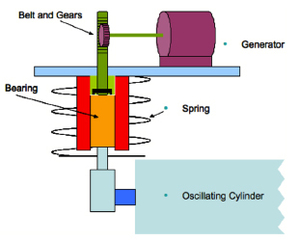
Schematic Prototypes of the device known as Vortex Induced
Vibrations Aquatic Clean Energy are essentially round
cylinders a few inches across suspended in water on a spring.
The vortices generated by water flow move the cylinder up and
down. The VIVACE system converts that mechanical energy into
electricity via rotary or linear generators.
In the future, Bernitsas wants to create modular 50 kilowatt
units, like the artist's rendering seen above. They could be
strung together for larger applications into power plants
producing as much as a gigawatt of power.
The engineers are working on making the basic system components
more efficient, too. The cylinders of the early designs have
sprouted tails, which allow them to use more of the energy in
the vortices. It's an idea that the engineer has borrowed from
whales, fish, tadpoles and other creatures that move in liquid,
which he says all have a bluff, or not slender, body followed by
a tail.
"The muscle power the fish have is not enough to support the
speed at which they are going," he said. "So, if you study more
carefully, there are lots of things going on. A fish will curve
its body, collect a vortex, shed it, and collect one on the
other side and shed that, alternating on the two sides of its
body."
The design of the system allows it to take much more energy out
of the water than turbine-based systems. In technical terms, the
energy density of the system is higher. For example, in a
three-knot current, the VIVACE gets 50 watts per cubic meter of
water, while the Pelamis system, considered the world leader in
ocean energy, gets 21.
The innovative nature of the idea, however, is no guarantee of
commercial success.
"I think that it's at a very, very early stage of development,"
said Roger Bedard, an analyst at the Electric Power Research
Institute in Palo Alto, California, and world expert on ocean
energy.
And Bernitsas' system would be subject to the United States'
regulatory process, which was designed with large hydroelectric
dam projects in mind, and that has hampered all hydrokinetic
energy technology development.
"You have to go through 20 to 25 different regulatory agencies
in this country," Bedard said.
Governmental risk frightens potential investors. Erik Straser
of the Silicon Valley-based venture capital firm Mohr Davidow
Ventures, sees potential regulatory and technical issues, too.
"This seems like it would be have some issues with permitting,"
Straser wrote in an e-mail to Wired.com. "I think that and
reliability will be the key issues to deployment and efficacy."
Bernitsas believes that his technology is much more
environmentally friendly than other marine projects, so he's
looking forward to working with regulators.
Still, the tide could be turning, no pun intended, for marine
and hydrokinetic projects. The recent Wall Street bailout bill
included tax credits for these projects, which could stir
investor interest.
For now, Bernitsas isn't focused on large-scale production just
yet. The first ready-to-use prototype, slated for splash down in
the Detroit River, will be ready in about a year.
"We're where cars were 100 years ago," Bernitsas said.
"Hopefully it won't take us 100 years to get where we need to
be."
---
[**http://www.newscientist.com/article/mg19826516.200-harnessing-river-whirlpools-puts-energy-on-tap.html**](http://www.newscientist.com/article/mg19826516.200-harnessing-river-whirlpools-puts-energy-on-tap.html)
( 11 April 2008 )
**Harnessing River Whirlpools Puts Energy on
Tap**
**by Jim Giles**
Whirlpools created by currents as they flow over obstacles are
powerful enough to tear apart bridges and offshore rigs. So why
not use them as a source of renewable power?
Previous attempts to harness energy from the flow of the
world's rivers and oceans have had limited success, at best.
Tidal flow can only be tapped at certain times of day, while
underwater turbines are only viable if they are mounted in rapid
currents.
Now researchers led by Michael Bernitsas at the University of
Michigan, Ann Arbor, are preparing for the first outdoor trials
of a technology that makes use of the slow-moving currents down
rivers and across the ocean.
When water flows over an underwater obstacle, whirlpools or
vortices form alternately above and below it. The vortices
create a tugging effect, so the result is an alternating force
that yanks the object up and down (see Diagram). It is these
oscillations that can have devastating consequences for rigs and
bridges, but Bernitsas has now created a device that turns them
into usable amounts of electricity.
In his lab, he took a cylinder 10 centimetres in diameter and
91 centimetres long with the same average density as water and
suspended it horizontally in a bath. Then he generated currents
of between 0.5 and 1.0 metres per second - speeds that are
common in rivers. The vortices generated by the flow moved the
cylinders up and down, and by attaching the cylinders to springs
that turn an electric generator he was able to convert the
motion into 10 watts of electrical energy. Bernitsas calls the
technology Vortex Induced Vibrations Aquatic Clean Energy, or
VIVACE, and plans to commercialise it with his company Vortex
Hydro Energy.
He has also come up with an idea for squeezing more energy from
VIVACE. At the Offshore Mechanics and Arctic Engineering
conference in Estoril, Portugal, in June this year, he will show
how roughening the surface of the cylinders allows them to
capture more energy. The idea was inspired by the fact that fish
that use energy from vortices to help propel themselves forward
also have rough skin.
VIVACE's big test will come next year, when the team plans to
deploy a larger version in the Detroit river. They expect it to
generate 3 kilowatts, enough to power lights on a nearby pier,
and claim that still larger versions could produce megawatts of
power at a cost of around 5 cents per kilowatt-hour. This would
make it competitive with coal and gas-fuelled generators.
These projections are contested, however, by commentators who
point out that the performance has yet to be tested in the
fluctuating current of a real river. They also have doubts about
the claimed cost of the power it produces, since it is not yet
clear how much the system will cost to maintain. "It is very new
and very different to existing devices," says Walter Musial of
the National Renewable Energy Laboratory in Golden, Colorado.
"There are a lot of questions still to be answered."
---
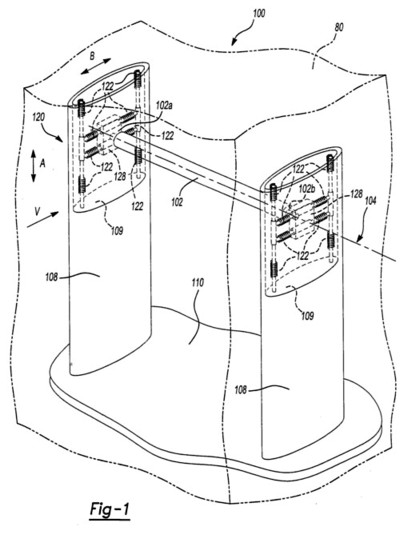
**WO2006055393**
**FLUID MOTION ENERGY CONVERTER**
2007-08-01
Inventor(s): BERNITSAS MICHAEL M [US]; RAGHAVAN KAMALDEV
[US]
Applicant(s): UNIV MICHIGAN [US]
Classification: - international: F03B13/12; F03C1/00;
F03B13/00; F03C1/00 ;- European: F03B17/06
Also published as: EP1812709
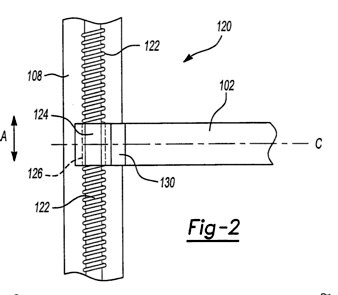
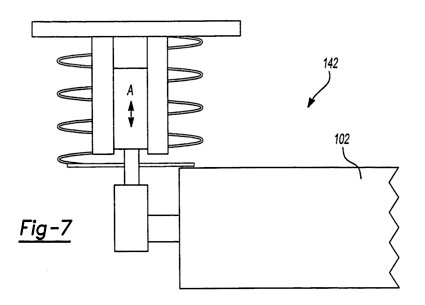
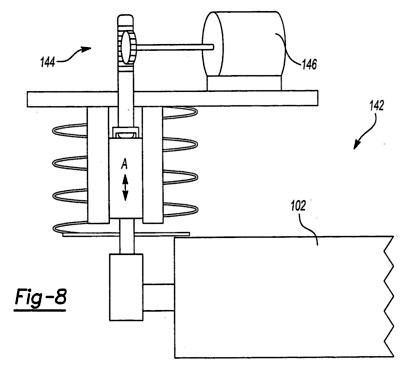
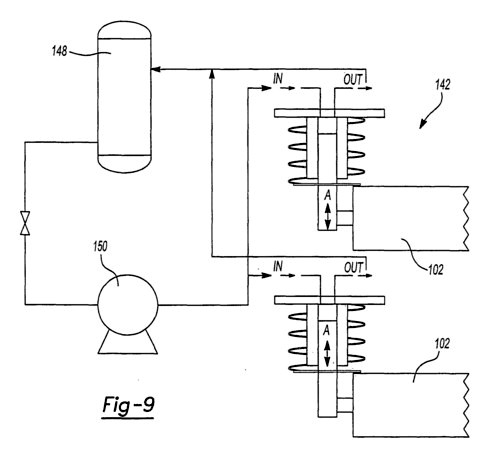
**Abstract** -- A converter for producing useable energy
from fluid motion of a fluid medium. The converter includes a
support structure, at least one movable element immersed in the
fluid medium and supported externally on the support structure
such that the movable element can move relatively to the
structure in response to the fluid motion by vortex induced
motion, galloping or combination thereof, and at least one power
device supported on the support structure and coupled to the
movable element. The power device converts motion of the movable
element to useable energy.
---